
What happens when a flight is diverted?
The plane lands at a different airport than planned, usually because of weather, a medical emergency, a technical problem or an issue at the destination. After landing, passengers may wait onboard or in the terminal while the airline decides whether to continue, swap aircraft or rebook everyone on other flights.
That’s the short version. What happens next depends a lot on why the plane diverted, where it landed, and which airline and laws apply. Here’s how it usually unfolds, and what you can do if it happens to you.
What Does It Mean When a Flight Is Diverted?
A diversion simply means the aircraft lands somewhere other than its scheduled destination, because the crew or the airline decides continuing isn’t appropriate or practical.
It helps to separate it from similar terms:
- Diversion: the flight lands at a different airport than planned.
- Emergency landing: a landing made because of an urgent problem. Many diversions involve one, but not all. Some are precautionary.
- Return to the departure airport: sometimes called an air turnback. The plane comes back to where it started.
- Delay: the flight still goes to its destination, just later.
- Cancellation: the flight doesn’t operate at all.
A diverted flight can turn into a delay (if it continues later) or effectively a cancellation (if passengers are rebooked on other flights). That distinction matters for passenger rights, as covered below.
Why Do Flights Get Diverted?
Common reasons include:
- Bad weather at the destination, such as thunderstorms, fog, snow or strong crosswinds
- Medical emergencies involving a passenger or crew member
- Mechanical or technical problems, from a warning light to a system failure
- Smoke, fumes or unusual odors in the cabin
- Airport closures or runway problems at the destination
- Air traffic restrictions, such as congestion or airspace closures
- Security concerns, including disruptive passengers
- Fuel and operational considerations, for example after long holding patterns caused by weather or traffic
A diversion doesn’t automatically mean the plane was in danger. Crews often divert because it’s the most cautious choice: a sick passenger needs a hospital, or a technical issue is better checked on the ground than across an ocean.
What Happens During a Flight Diversion?
The exact process varies, but it typically looks like this:
- The crew decides a diversion is needed. Pilots usually consult the airline’s operations team, though in urgent situations the captain can decide immediately.
- Air traffic control coordinates a new destination. Controllers clear the plane toward the chosen alternate airport.
- The aircraft changes course. Passengers often hear an announcement from the cockpit at this point.
- The alternate airport prepares. Ground staff, gates and, if needed, medical or fire crews get ready.
- Emergency services may meet the aircraft. For medical issues, smoke or fumes, it’s common to see vehicles waiting on arrival. That’s standard procedure, not necessarily a sign of serious danger.
- The plane lands.
- Passengers either stay onboard or get off. This depends on how long the stop is expected to be and what the airport can handle.
- The airline decides what’s next: continue, swap planes or rebook passengers.
What Happens to Passengers After the Plane Lands?
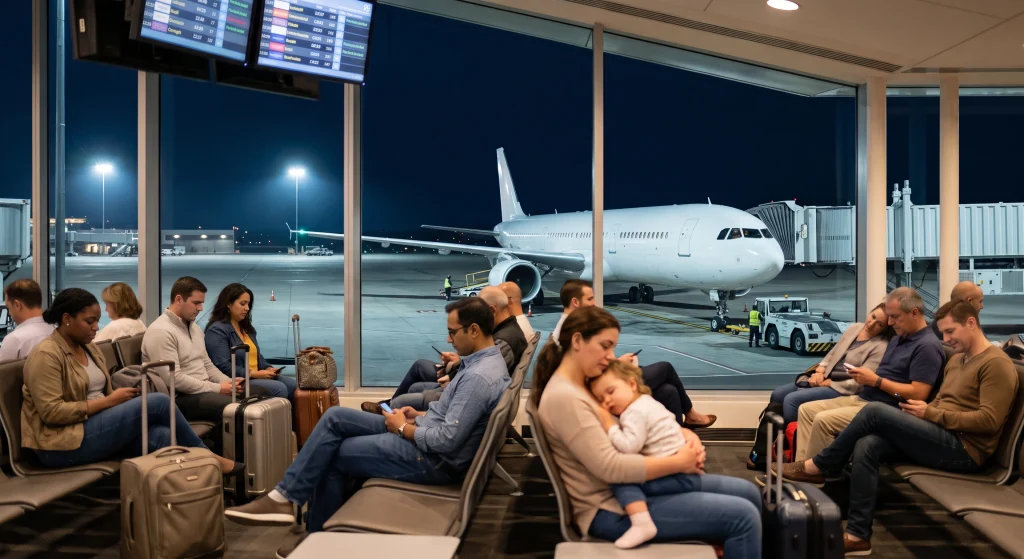
This is where things vary most. Common scenarios:
- You stay onboard. If the stop is short, such as dropping off a sick passenger or refueling after weather, the plane may continue within an hour or two.
- You get off and wait in the terminal. Longer stops usually mean deplaning. If the alternate airport is in another country, you may go through immigration.
- The aircraft is inspected. After a technical issue, engineers check the plane before it can fly again. That can take hours or longer.
- The airline brings in another aircraft. If the original plane can’t continue, a replacement may be flown in.
- The original aircraft continues later. This can happen after a repair or once crew and conditions allow.
- You’re rebooked on other flights. Common when the delay would be long.
- Ground transport is arranged. If the alternate airport is close to the original destination, buses or other transport are sometimes used.
Crew working hours are a hidden factor here. Pilots and flight attendants have strict duty limits. If a diversion pushes them past those limits, the flight can’t continue until a rested crew is available, which often means an overnight stay.
If you’re stuck on the plane in the US
US rules set limits on how long you can be kept onboard during a tarmac delay at a US airport. Under DOT rules, most airlines must give passengers the chance to deplane before three hours on domestic flights and four hours on international flights, with exceptions for safety, security or air traffic control reasons. Airlines must also provide food and water within two hours. Delta’s own tarmac delay plan states that these rules apply to diverted flights too.
What Happens to Your Checked Baggage?
It depends on the situation, so don’t assume.
- If the plane continues, your bags usually stay onboard.
- If you’re rebooked, bags may be unloaded and transferred to your new flight, or held until you collect them.
- If you’re staying overnight, you may not get your checked bags back that night. Security rules and airport staffing can affect what’s possible.
- If you leave the airport on your own, don’t assume your bag will automatically follow you to your destination.
Ask the airline staff directly where your bag is going and when you’ll see it. Keep essentials (medication, chargers, a change of clothes) in your carry-on, since that’s what you’ll have if you end up in a hotel.
What Happens to Connecting Flights?
If a diversion makes you miss a connection:
- Check the airline’s app first. Airlines often rebook automatically, and the app may show your new flight before staff can announce it.
- Talk to the airline or transfer desk at the airport if the app doesn’t help.
- Ask about your bags and whether they’ll be rerouted to your new flight.
- Keep records of everything: boarding passes, new itineraries and receipts.
If all your flights are on one ticket, the airline is generally responsible for getting you to your final destination. If you booked separate tickets, the second airline may treat you as a no-show, and your options depend on that airline’s policies.
Does the Airline Pay for a Hotel After a Flight Is Diverted?
There’s no single worldwide rule. Whether you get a hotel depends on where your flight departed and was headed, the airline, the reason for the diversion, and which passenger-rights laws apply.
In the EU: EU air passenger rights apply to flights departing from the EU on any airline, flights arriving in the EU on an EU airline, and flights within the EU. Under those rules, when you’re waiting for re-routing after a cancellation or long delay, airlines must provide meals, refreshments and, if you need to stay overnight, a hotel and transport to it. If the airline doesn’t offer that and you pay yourself, it should reimburse reasonable expenses, so keep receipts.
In the US: there’s no federal law requiring airlines to provide hotels or meals during disruptions. Many US airlines make their own commitments when a delay or cancellation is caused by something within their control, such as maintenance, and the DOT’s Airline Customer Service Dashboard shows what each major airline has committed to. Weather-related disruptions usually aren’t covered.
Elsewhere: other countries have their own rules, and some have none. Check the airline’s conditions of carriage.
Can You Get Compensation for a Diverted Flight?
Not automatically. It helps to know the four types of help airlines may owe you:
- Re-routing: getting you to your destination another way
- Reimbursement: a refund for the unused part of your ticket
- Care and assistance: meals, hotels, transport and communication while you wait
- Monetary compensation: a fixed cash payment for the disruption
Under EU rules, a flight that lands at an airport other than your final destination is treated as a cancellation, unless the airport serves the same city or region, or you accept re-routing. In those cases, it’s treated as a delay. If you accept a flight to a different airport, the airline must cover the transport between that airport and your original destination.
Compensation is due if you reach your final destination three hours or more late, unless the airline can prove extraordinary circumstances. The EU lists air traffic management decisions, political instability, adverse weather and security risks as examples, but says most technical problems from maintenance or failure to maintain an aircraft don’t qualify. Amounts depend on flight distance, from €250 to €600.
In the US, there’s no law requiring cash compensation for delays or diversions. The DOT’s refund rule does require refunds when an airline cancels or significantly changes your flight and you choose not to travel. A change to a different arrival airport is one of the listed significant changes. Whether and how that applies to a diversion during your trip depends on the specifics, so ask the airline and check the DOT’s guidance.
What Should You Do If Your Flight Is Diverted?
- Stay calm and follow crew instructions. Their first job is safety.
- Check the airline’s app for rebooking and updates.
- Confirm where you’ve landed and whether you’ll need to pass through immigration.
- Ask about your next flight before making plans of your own.
- Ask about your checked baggage.
- Keep everything: boarding passes, receipts and any written notices.
- Ask about meals and hotels if you’re facing a long wait or an overnight stay.
- Contact the airline before booking expensive alternatives yourself, since you may not be reimbursed.
- Check your travel insurance and the travel benefits on the credit card you used.
- Write down times (landing, deplaning, final arrival), which help if you file a claim later.
Real-World Example: Delta Flight Diverted to Porto
A recent diversion shows how this plays out. On September 27, 2026, Delta Flight 251 from Barcelona to Boston diverted to Porto, Portugal. Delta said the flight diverted following a reported mechanical issue, and fumes were reported in the cabin. The Airbus A330-300 landed safely with 283 customers and 13 crew onboard.
Emergency personnel met the plane, and some passengers received medical attention. Early reports varied on how many were treated. Delta later said three passengers had been hospitalized and discharged, and two crew members sought medical attention. The airline said it was working to rebook customers to their final destinations.
It’s a good illustration of several points above: a technical issue, a diversion to the nearest suitable airport, medical crews waiting on arrival, and passengers then needing new travel arrangements. Because the flight departed from Spain, EU passenger rights also came into play. You can read more about what happened when Delta Flight 251 diverted to Porto.
How Long Does a Flight Diversion Take?
There’s no standard answer. A diversion can add under an hour, or turn into an overnight stay. It depends on:
- Distance to the alternate airport
- Weather, both at the alternate and the original destination
- Airport availability and gate space
- Inspections and repairs, if a technical issue is involved
- Passenger handling, such as immigration or medical care
- Aircraft availability, if a replacement plane is needed
- Crew duty limits, which can force an overnight stop
- Rebooking logistics, especially on busy routes with few spare seats
A weather diversion might wait out a storm and continue the same day. A technical issue far from the airline’s maintenance base can take much longer.
Is a Flight Diversion Dangerous?
Usually, a diversion is a safety or operational decision, made because the crew decided another airport was the better choice. Many are precautionary, and the vast majority end with a normal landing.
That said, some diversions do involve real emergencies, such as a serious medical event or smoke in the cabin. The diversion itself is the safety response: it gets the aircraft on the ground where help is available.
Frequently Asked Questions
What happens when a flight is diverted?
The plane lands at a different airport than planned. Passengers then wait onboard or in the terminal while the airline decides whether to continue, change aircraft or rebook them.
Why would a plane be diverted?
Common reasons include bad weather, medical emergencies, technical problems, smoke or fumes, airport or runway closures, air traffic restrictions and security concerns.
Do passengers get off the plane after a diversion?
It depends. For short stops, passengers often stay onboard. For longer delays, they usually deplane into the terminal. In the US, airlines must generally let passengers off before three hours on domestic flights and four hours on international flights.
What happens to checked baggage during a diversion?
Bags usually stay onboard if the plane continues. If you’re rebooked or staying overnight, they may be transferred or held. Ask the airline rather than assuming.
What happens if I miss my connecting flight because of a diversion?
Check the airline’s app and speak to the airline. If all flights are on one ticket, the airline generally rebooks you to your final destination.
Does the airline pay for hotels after a diversion?
Under EU rules, yes, when you need an overnight stay while waiting for re-routing on a covered flight. In the US, there’s no legal requirement, but many airlines offer hotels when the cause is within their control.
Can I get compensation for a diverted flight?
Under EU rules, possibly, if you arrive three hours or more late and the cause wasn’t an extraordinary circumstance. US law doesn’t require cash compensation.
How long can passengers be stuck after a diversion?
Anywhere from under an hour to overnight, depending on the cause, repairs, crew duty limits and available flights.
Can a diverted plane continue to its original destination?
Yes, often. Once weather clears, a passenger is offloaded or a technical issue is resolved, the same plane may continue. Otherwise, the airline uses another aircraft or rebooks passengers.
Sources
- Your Europe (European Commission): Air passenger rights
- U.S. DOT: Fly Rights
- Federal Register: Tarmac Delay Rule
- U.S. DOT: What passengers need to know about the automatic refund rule
- U.S. DOT: Airline Customer Service Dashboard
- Delta: Contingency plan for lengthy tarmac delays
- NBC Boston
- The Boston Globe




One Comment