Key Takeaways
- A simple at home workout can be done in 15 minutes with zero equipment
- Focus on 5 to 6 fundamental movements that work your whole body
- Consistency matters more than duration, especially in the first few weeks
- Pair exercise with proper breathing for better results and safety
- Track your progress by noting how many rounds you complete, not how heavy you lift
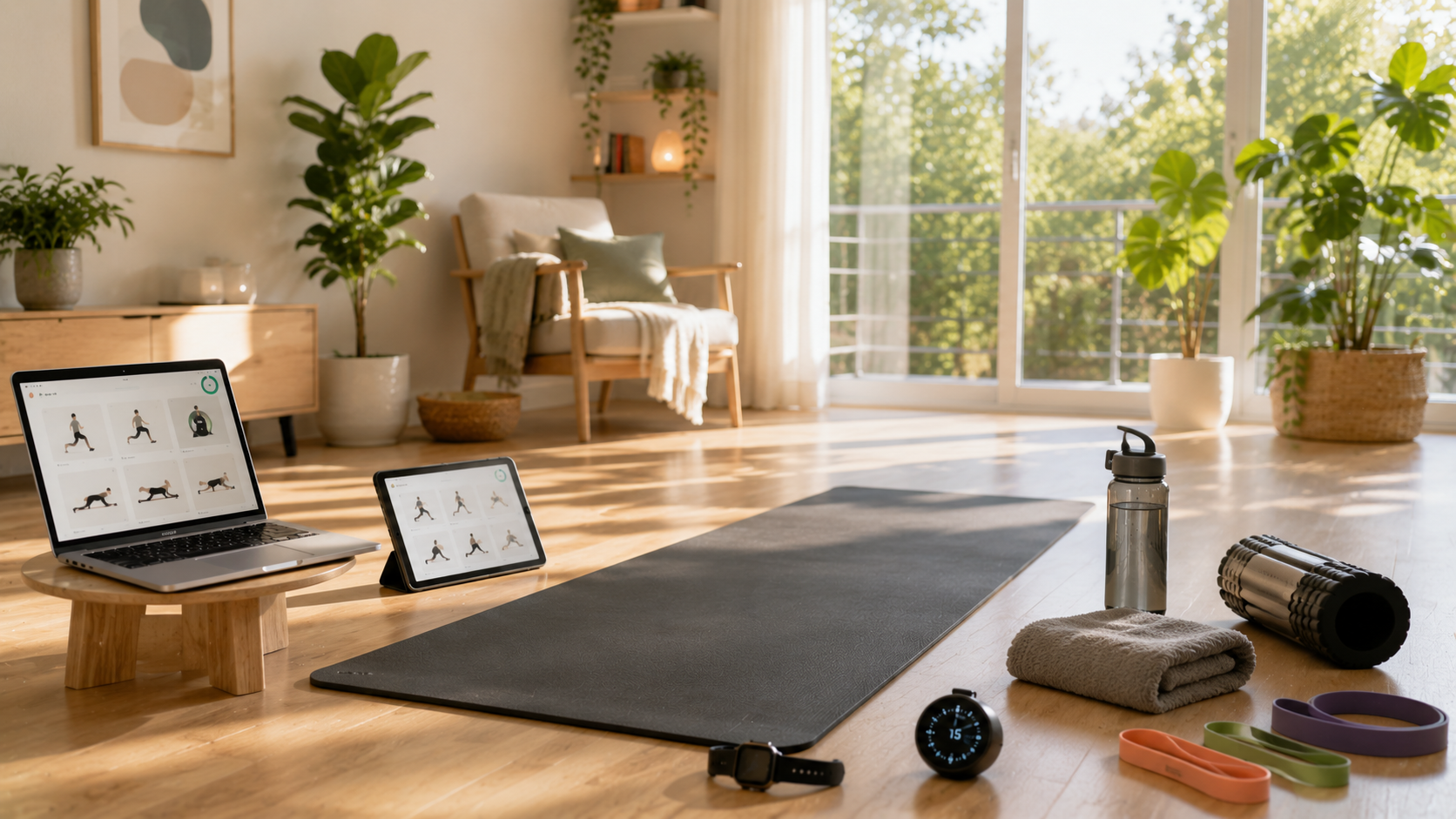
Fitness does not need to be complicated. The best workout is the one you actually do, and a simple at home workout removes every excuse. No commute. No equipment. No complex routines to memorize. This guide gives you a straightforward workout you can do in any living room, at any time, with nothing but your own body.
The Philosophy of Simple Training
Most beginners quit fitness programs because they are too complicated. They try to follow elaborate YouTube routines with 15 different exercises, confusing rep schemes, and technical cues that mean nothing to someone just starting out. Simple training flips that approach. You learn 5 to 6 foundational movements, practice them consistently, and only add complexity once the basics feel automatic.
This approach works because it builds a habit first and optimizes the workout second. A simple routine done 3 times per week for 8 weeks will transform your body more than a complex routine done once or twice and abandoned.
The 15-Minute Simple Workout
Perform each exercise for 40 seconds. Rest for 20 seconds between exercises. Complete all 6 exercises in order, rest for 60 seconds, then repeat for a total of 2 rounds.
1. Squats (40 seconds)
The squat is the single most valuable lower body exercise. Stand with feet hip-width apart, lower your hips back and down, and return to standing. Keep your weight in your heels and your chest facing forward. If you cannot go all the way down, go as far as you can and improve over time.
2. Incline Push-Ups (40 seconds)
Place your hands on a sturdy surface like a couch, bed, or table. Walk your feet back until your body is in a straight line. Lower your chest toward the surface and push back up. The higher the surface, the easier the exercise. Lower it over weeks as you get stronger.
3. Alternating Reverse Lunges (40 seconds)
Step your right foot back and lower into a lunge. Push through your left heel to return to standing. Alternate legs. Keep your torso upright and your front knee aligned with your ankle.
4. Dead Bug (40 seconds)
Lie on your back with arms extended toward the ceiling and knees lifted to 90 degrees. Slowly extend your right arm behind you and your left leg straight out, keeping your lower back pressed into the floor. Return to center and switch sides. This builds core stability without straining your neck or lower back.
5. Glute Bridge Hold (40 seconds)
Lie on your back with knees bent and feet flat. Lift your hips and hold at the top for the full 40 seconds. Squeeze your glutes throughout. If you cannot hold for 40 seconds, pulse up and down instead while keeping tension.
6. Standing Calf Raises (40 seconds)
Stand on the edge of a step or a sturdy book with your heels hanging off. Rise up onto your toes, pause, and lower below the step level for a deeper stretch. This finishes the circuit and builds ankle stability.
How to Warm Up for This Workout
Before each session, spend 3 minutes doing simple mobility work. Neck rolls (30 seconds), shoulder rolls forward and back (30 seconds), torso twists (30 seconds), leg swings front to back (30 seconds per leg), ankle circles (15 seconds per ankle). This prepares your joints and reduces injury risk without adding significant time to your workout.
Making This Routine a Habit
Habit formation matters more than workout quality in the beginning. Follow the two day rule: never miss two workouts in a row. If you miss Monday, you do Tuesday no matter what. Pair your workout with an existing habit like brushing your teeth in the morning or making coffee. This creates a trigger that makes skipping harder. Lay your workout clothes out the night before to reduce friction. Start with just 1 round for the first week if 2 rounds feels overwhelming. You can always add more later.
When to Progress
After 3 to 4 weeks of consistent training, increase the challenge by adding a third round to your workout, increasing work time from 40 to 50 seconds per exercise, reducing rest from 20 to 10 seconds between exercises, or progressing to harder variations like full push-ups or pistol squat progressions.
For variety, mix in the calisthenics workout for beginners on alternating days or try the best bodyweight exercises for beginners for a different movement selection. You can also pair this with the cardio exercise at home for beginners routine on separate days for a complete weekly program.
Conclusion
A simple at home workout is all you need to start seeing real changes in your strength, energy, and confidence. Fifteen minutes, 6 exercises, 3 times per week. That is the formula. Do not overthink it. Start today, stay consistent, and let the results speak for themselves.
Author: Jessica Moore is a holistic health and fitness writer who helps beginners build sustainable wellness habits. Her work focuses on practical strategies for strength training, cardio, sleep, and mental health.