
Beginner Cardio Workout at Home: Easy Exercises and a Simple Routine
If you want to start cardio but don’t have a gym membership, equipment or much fitness yet, you can start in your living room today. A beginner cardio workout at home needs about 20 minutes, a small clear space and a few simple movements, many of which don’t involve any jumping.
This guide explains what cardio is, gives you eight beginner-friendly exercises and a complete routine to follow, and shows you how long to exercise, how often, and how to make it harder as you improve.
What Is Cardio?
Cardio, short for cardiovascular exercise, is any activity that keeps large muscles moving long enough to raise your heart rate and breathing. It’s also called aerobic exercise.
Walking, dancing, cycling and swimming are all cardio, and so are many movements you can do at home. Your heart pumps faster to deliver oxygen to your working muscles, and over time your heart and lungs get better at that job.
According to the U.S. Physical Activity Guidelines, regular aerobic activity lowers the risk of heart disease, stroke and several other conditions.
You don’t need high-intensity workouts to get these benefits. The CDC gives a simple way to judge intensity, called the talk test. During moderate-intensity activity, you can talk but not sing. During vigorous activity, you can only say a few words before pausing for breath. Moderate intensity is the right target for most beginners.
Is Cardio at Home Effective for Beginners?
Yes. Home cardio can improve your fitness as long as you do it regularly and gradually make it harder. Your heart doesn’t care whether you’re on a treadmill or marching in your living room. What counts is that you keep moving at a suitable effort, often enough.
Home workouts also remove common obstacles. There’s no travel, no cost and no one watching. For beginners, that often makes the biggest difference: the best workout is the one you’ll actually keep doing.
The key is to match the effort to your current fitness. Someone who hasn’t exercised in years will get more from steady marching three times a week than from an intense workout that leaves them sore and discouraged.
Best Beginner Cardio Exercises to Do at Home
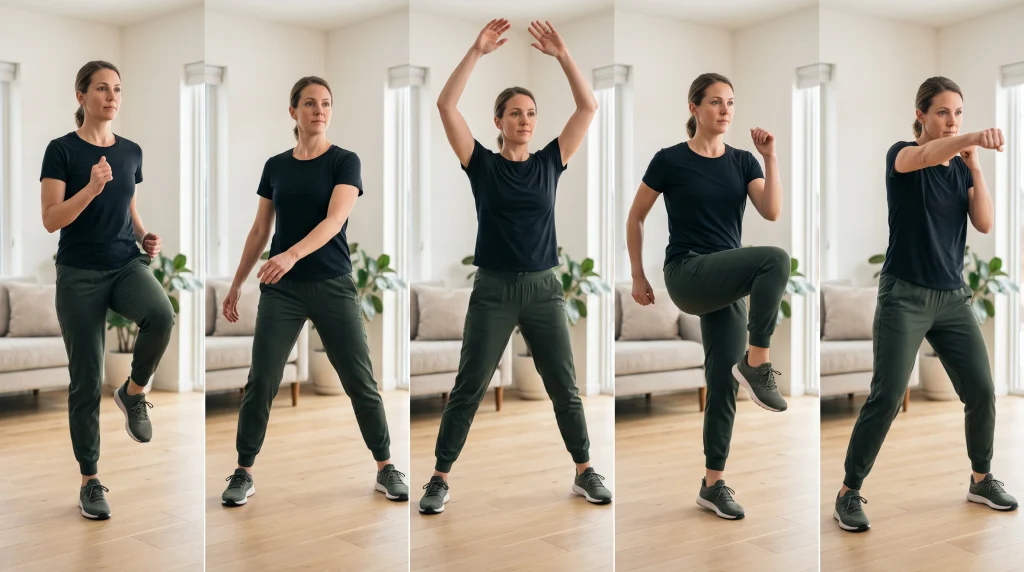
These exercises were chosen because they’re easy to learn, need no equipment, and can be made easier or harder. Not every exercise suits every person. Skip any that cause pain, and use the easier versions when you need them.
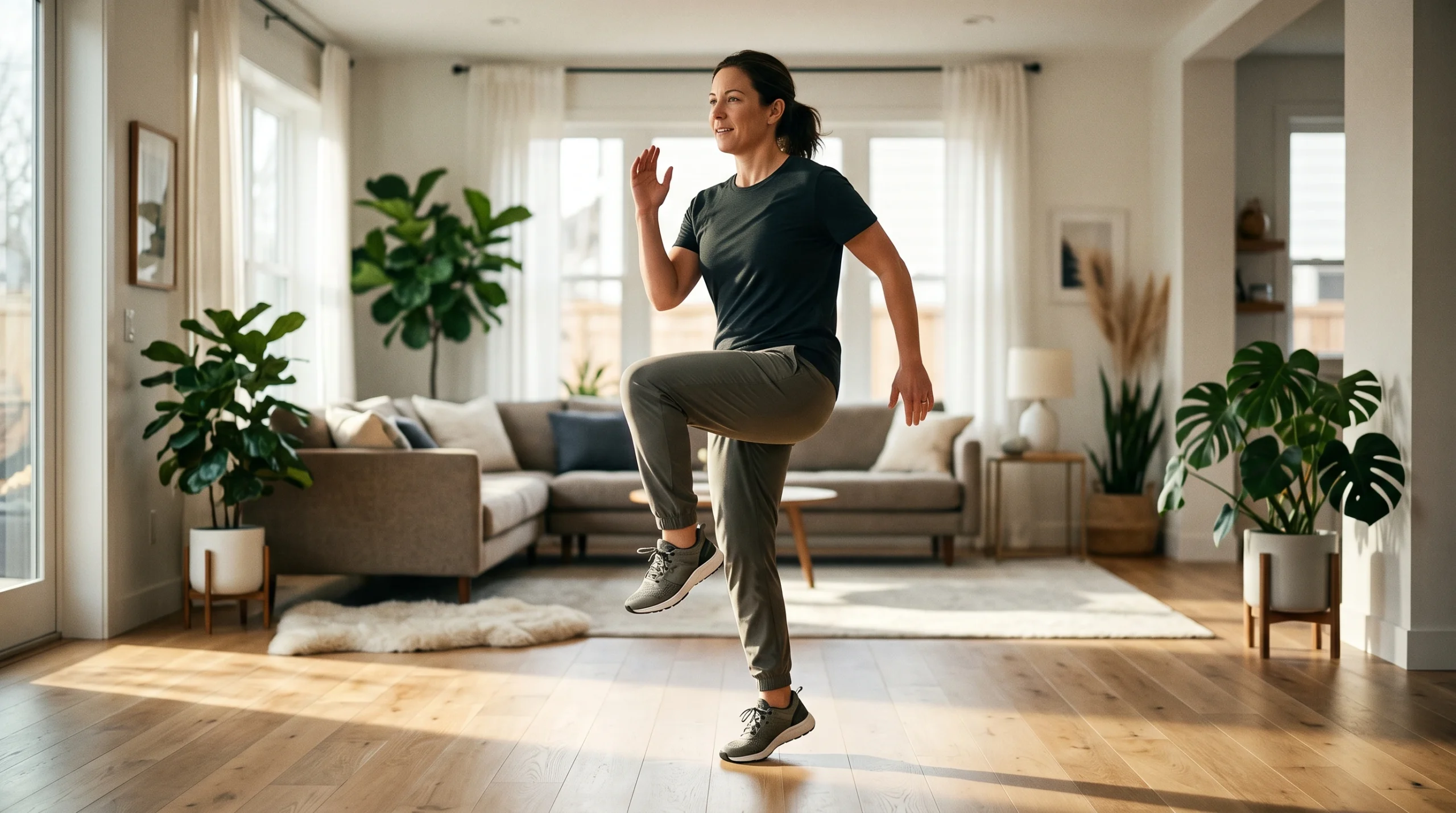
Marching in Place
Stand tall and march, lifting your knees to a comfortable height and swinging your arms naturally.
Make it easier: hold the back of a chair for balance.
Why it’s good for beginners: it’s the simplest way to raise your heart rate without any jumping.
Step Touches
Step your right foot out to the side, then bring your left foot in to meet it. Repeat to the other side, and keep a steady rhythm. Add arm swings or raise your arms overhead to make it more challenging.
Why it’s good for beginners: it’s low impact, rhythmic and easy to keep going.
Low-Impact Jumping Jacks
Instead of jumping, step one foot out to the side as you raise both arms overhead. Bring the foot back in as you lower your arms. Alternate sides.
Why it’s good for beginners: you work your whole body without the impact of a regular jumping jack.
Bodyweight Squats
Stand with your feet about shoulder-width apart. Push your hips back and bend your knees as if sitting into a chair, then stand back up. Keep your chest up and your knees in line with your toes.
Make it easier: squat down to touch a real chair, then stand up.
Why it’s included: squats work large leg muscles, which raises your heart rate in a circuit and adds some strength work.
Alternating Knee Raises
Lift one knee toward your hips while bringing the opposite elbow toward it, then switch sides at a steady pace.
Why it’s good for beginners: it’s easy to control, and you can speed it up as you get fitter.
Shadow Boxing
Stand with your feet staggered and your knees soft. Throw light, controlled punches straight ahead, alternating arms, while shifting your weight gently from foot to foot. This is for fitness, not technique, so keep it relaxed and don’t lock your elbows.
Why it’s good for beginners: it gets your upper body involved and many people find it fun.
Step-Ups on the Bottom Stair
Step up onto the bottom stair with one foot, bring the other foot up, then step back down. Alternate your leading foot every minute or so.
Safety: only use a sturdy stair with a handrail. Hold the rail, and don’t do this if your balance is unsteady. If you don’t have a safe step, march in place instead.
Low-Impact High Knees
This is a quicker march with your knees lifted higher, without jumping. Keep your posture upright and land softly.
Why it’s included: it’s a slightly harder exercise to add once marching feels easy.
A Simple Beginner Cardio Workout at Home
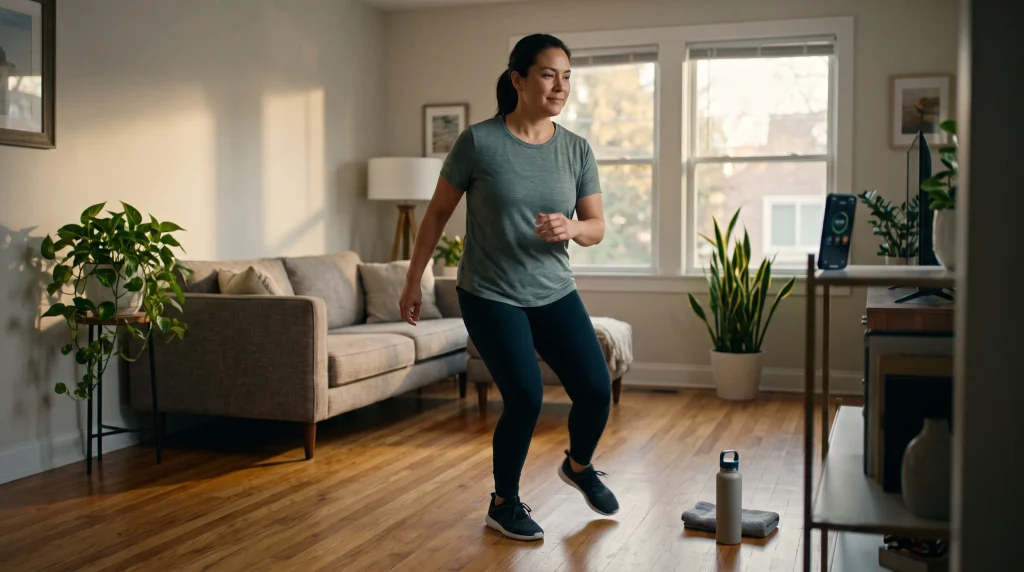
This full routine takes about 16 to 22 minutes. The numbers are a starting point, not a rule. Shorten the exercise time, take longer rests, or do one round if that’s what your body needs.
Warm-up (about 5 minutes)
- 2 minutes of easy marching in place
- 30 seconds of shoulder rolls
- 1 minute of gentle step touches
- 1 to 2 minutes of slow, controlled knee raises
Main workout (1 to 2 rounds)
Do each exercise for 30 seconds, then march slowly or rest for 30 seconds before the next one.
| Order | Exercise |
|---|---|
| 1 | Marching in place (brisk) |
| 2 | Step touches with arm swings |
| 3 | Low-impact jumping jacks |
| 4 | Bodyweight squats |
| 5 | Alternating knee raises |
| 6 | Shadow boxing |
One round takes about 6 minutes. Start with one round. Do a second round when the first one feels manageable.
Cool-down (about 5 minutes)
- 2 to 3 minutes of slow marching or walking around the room, so your breathing settles
- Gentle stretches for your calves, thighs and shoulders
During the main workout, aim for the talk test: breathing faster, but still able to talk.
How Long Should a Beginner Do Cardio?
Beginners can start with short, manageable sessions, even 5 to 10 minutes, and build up gradually.
The U.S. guidelines recommend at least 150 minutes of moderate aerobic activity per week for adults. The NHS gives the same target. But that’s a goal to build toward, not where you have to start. The U.S. guidelines also say that any amount of activity has some health benefits, and they no longer require sessions to last at least 10 minutes.
A realistic path for someone who’s currently inactive:
- Weeks 1 to 2: one round of the routine (about 16 minutes including warm-up and cool-down), 3 days a week
- Weeks 3 to 4: two rounds when one feels comfortable
- After that: add a few minutes or another session each week, until you’re doing about 30 minutes on most days, if that suits you
Rest between exercises for as long as you need. As your fitness improves, you’ll need less rest.
How Many Days a Week Should Beginners Do Cardio?
Start with 3 days a week on non-consecutive days, such as Monday, Wednesday and Friday. This gives your body time to adjust and makes the routine easier to stick with.
As you get fitter, add a fourth or fifth day. The NHS suggests spreading activity over 4 to 5 days a week, or doing some every day. Moderate cardio can be done on most days once you’re used to it. Short walks also count toward your weekly total.
The guidelines also recommend muscle-strengthening activities on at least 2 days a week. Squats in the routine help with this, but a separate session adds more benefit. Our beginner guide to strength training for weight loss shows you how to get started.
Doing steady, moderate workouts every week beats doing an exhausting workout once in a while.
Low-Impact Cardio Options for Beginners
“Low impact” means at least one foot stays on the ground. It’s still real cardio, and it can raise your heart rate effectively, especially when you move briskly and use your arms.
Good low-impact options at home include:
- marching in place
- step touches
- walking around your home or garden
- knee raises
- dancing to music you enjoy
- controlled bodyweight movements, such as squats and shadow boxing
If jumping feels uncomfortable for your joints, or you’d rather avoid noise for neighbors, you can do every exercise in this guide without jumping.
How to Make Your Home Cardio Workout Harder
Make it harder gradually, changing only one thing at a time:
- Add time. Go from 30 to 40 seconds per exercise.
- Add a round. Do two or three rounds instead of one.
- Shorten the rest. Go from 30 seconds of rest to 20.
- Move faster. Speed up your marching, step touches or knee raises.
- Make the movements bigger. Raise your knees higher, swing your arms wider, or squat a little deeper, while keeping control.
- Add variety. Swap in new exercises to keep it interesting.
- Add impact only if it feels right. Regular jumping jacks are fine later on, but stay with low-impact versions if jumping causes discomfort.
Feeling challenged is normal. Pain is a sign to ease off, not to push through.
Common Beginner Cardio Mistakes
- Going too hard at the start. If you can’t talk at all, slow down.
- Doing too much too soon. Build up over weeks, not days.
- Skipping the warm-up. Five easy minutes prepares your body for the workout.
- Not taking rest days. Recovery is part of training.
- Focusing only on calories burned. Fitness improves even when the calorie count is small.
- Letting your form slip. Controlled movement matters more than speed.
- Treating soreness as proof the workout worked. Some soreness is normal, but it’s not a sign of a good workout.
- Comparing yourself with advanced exercisers. Compare yourself with where you were last month.
- Quitting too early. The first couple of weeks are the hardest. Most people find workouts get easier with practice.
Can Beginner Cardio Help With Weight Loss?
It can help, but it isn’t guaranteed. Cardio uses energy, and regular activity supports weight management. Whether you lose weight depends mostly on your overall balance of food and activity, along with sleep and other lifestyle factors. Home cardio on its own, without changes to eating habits, often leads to modest changes on the scale If you’re tracking your progress, it helps to know what a healthy rate of weight loss per week looks like..
No exercise burns fat from one specific area, such as your stomach. Cardio is still worth doing for your heart, energy and fitness, even if your weight changes slowly. If weight loss is your main goal, our weight loss workout plan for beginners shows how to combine cardio and strength training across a week.
Safety Tips for Beginners
- Start gradually, and build up over weeks.
- Clear your space. Move furniture, rugs and cables out of the way.
- Wear supportive shoes if you have them, or exercise barefoot on a non-slip surface. Socks on smooth floors can slip.
- Use support if your balance isn’t steady. Keep a chair or wall nearby.
- Drink water before and after your workout.
- Know the difference between normal effort and warning signs. Faster breathing, sweating and tired legs are normal. Stop and get medical help if you have chest pain, severe breathlessness, dizziness or feel faint, or pain that’s sharp or doesn’t settle.
The NHS advises speaking to your doctor first if you haven’t exercised for some time, or if you have a medical condition or health concerns.
Frequently Asked Questions
Can beginners do cardio at home?
Yes. Marching, step touches and other low-impact moves need no equipment, and they can improve fitness if you do them regularly.
What is the easiest cardio exercise for beginners?
Marching in place. It’s easy to learn, low impact, and you can hold a chair for balance.
How long should a beginner cardio workout be?
Around 15 to 20 minutes, including the warm-up and cool-down, is a good start. If that’s too much, start with 5 to 10 minutes.
Is 10 minutes of cardio enough for a beginner?
It’s a worthwhile start. Any amount of activity has some health benefits. Build up gradually toward 150 minutes a week.
How many days a week should a beginner do cardio?
Three days a week on non-consecutive days, then build up to most days as it gets easier.
Can I do cardio every day as a beginner?
Gentle activity like walking is fine daily. For structured workouts, take rest days at first, and add more days once your body adapts.
Can home cardio help with weight loss?
It can support weight loss as part of a broader approach that includes eating habits and overall activity, but results vary and aren’t guaranteed.
Conclusion
You don’t need extreme workouts, special equipment or a gym to start cardio. A short routine of marching, step touches and other simple moves, done a few times a week and made a little harder over time, builds real fitness. Start at a level that feels manageable today, and let consistency do the work.
Sources
- CDC: Measuring Physical Activity Intensity, on the talk test and examples of moderate activity
- ODPHP: Top 10 Things to Know About the Physical Activity Guidelines, on 150 to 300 minutes a week, the benefits of any amount of activity, and no 10-minute minimum
- CDC: Adult Activity, An Overview, on 150 minutes of aerobic activity plus 2 days of strength work
- NHS: Physical activity guidelines for adults, on spreading activity over 4 to 5 days, the talk test, and speaking to a GP first
- Moving Medicine (Faculty of Sport and Exercise Medicine UK): Chest pain, on when to stop and get urgent help



2 Comments