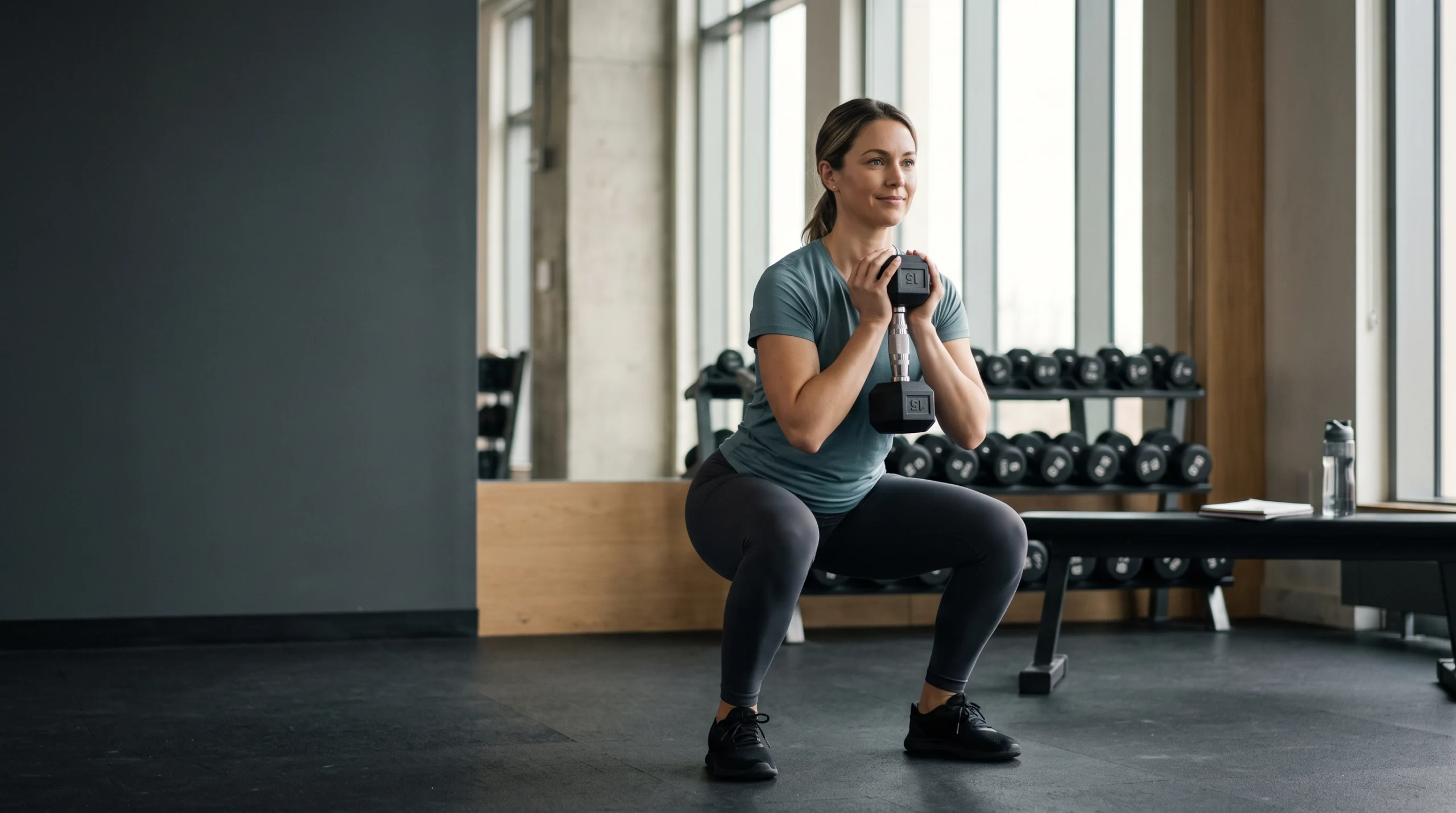
Strength Training for Weight Loss: A Beginner-Friendly Guide
Strength training can play a useful role in weight loss, just not in the way most fitness ads suggest. Lifting weights won’t melt fat from a specific body part, and on its own it usually causes less change on the scale than people expect. What it does well is help you keep and build muscle while you lose fat. It also makes everyday movement easier, and it combines well with cardio and sensible eating.
This guide explains what strength training for weight loss can realistically do, which exercises to start with, how many sets and reps to aim for, and how to progress safely if you’ve never lifted before.
Does strength training help with weight loss?
Yes, as part of a broader plan. Strength training helps you preserve and build muscle while you lose weight, so more of the weight you lose comes from fat. On its own it typically produces modest changes on the scale. It works best combined with aerobic activity and healthy eating habits.
What Is Strength Training?
Strength training is any exercise where your muscles work against resistance to get stronger. These terms overlap and are often used interchangeably:
| Term | What it usually means |
|---|---|
| Strength training | Training to improve muscular strength, using any type of resistance |
| Resistance training | Muscles working against a force: bodyweight, bands, weights or machines |
| Weight training | Resistance training with external weights, such as dumbbells or machines |
| Weight lifting | Lifting weights in general. It can also mean the competitive sport of Olympic weightlifting. |
For a beginner, the practical point is the same: you don’t need a barbell. Bodyweight exercises and resistance bands count.
Does Strength Training Help With Weight Loss?
It helps, but mostly in indirect ways.
It burns energy, though usually less than people think. A strength session uses energy, but typically less per minute than steady cardio like brisk walking or cycling. Lifting alone generally isn’t the fastest way to change the number on the scale.
It protects muscle while you lose weight. This is the main benefit. When people lose weight, some of the loss can come from muscle as well as fat. The American College of Sports Medicine’s position stand on weight loss concludes that resistance training doesn’t greatly increase the amount of weight lost, but it can increase lean mass and the loss of fat mass. In other words, strength training for fat loss is about what you lose, not just how much.
It changes body composition. Because you may be adding some muscle while losing fat, your clothes can fit differently and your strength can improve even when the scale barely moves.
It supports long-term activity. Stronger legs, hips and back make walking, climbing stairs and other activity easier, and that adds up over weeks and months.
Weight change depends on many things at once: what you eat, how active you are overall, sleep, medications and health conditions. No single type of exercise guarantees a set result.
Strength Training vs. Cardio for Weight Loss
You don’t have to choose between them. They do different jobs.
| What it does best | |
|---|---|
| Cardio (walking, cycling, swimming) | Burns more energy per session, builds heart and lung fitness, and is easy to do often |
| Strength training | Builds and preserves muscle, improves strength and physical function, and supports body composition while you lose weight |
The U.S. Physical Activity Guidelines recommend that adults do both: 150 to 300 minutes of moderate aerobic activity a week, plus muscle-strengthening activities on at least two days a week that work all the major muscle groups.
For most beginners, combining the two is a better plan than doing only one. Our guide to cardio for weight loss [INTERNAL LINK: Best Cardio for Weight Loss] covers the aerobic side.
Benefits Beyond Weight Loss
The main U.S. and UK public health guidelines recognize several benefits of regular muscle-strengthening activity beyond weight:
- Greater muscular strength, which makes lifting, carrying and climbing easier
- Better physical function, meaning everyday movements like getting up from a chair or the floor
- Bone health, since weight-bearing and resistance exercise put healthy stress on bones
- Overall fitness and health, as part of a regular activity routine
For many people, these benefits are a good reason to keep training even during weeks when the scale doesn’t move.
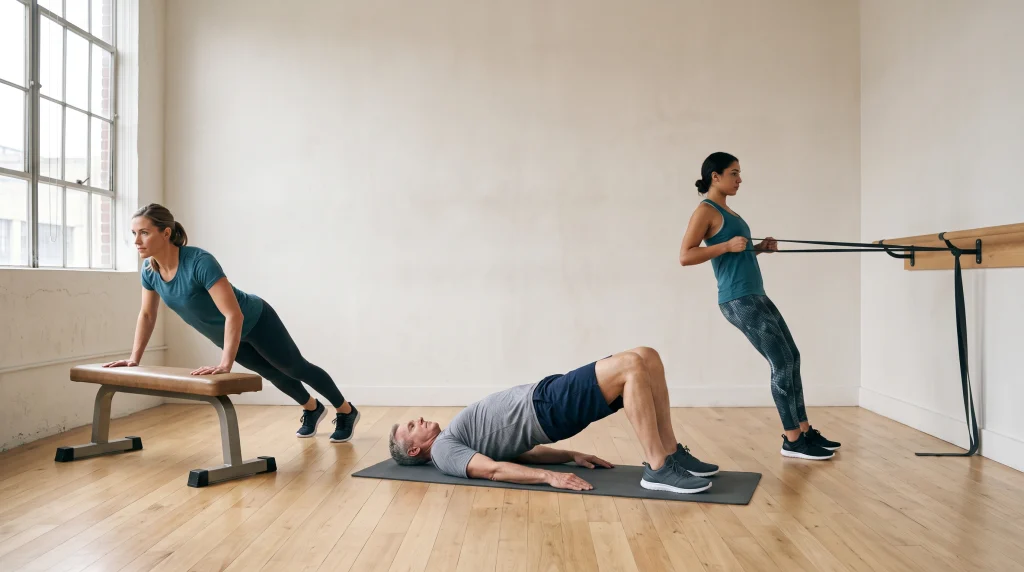
Best Strength Training Exercises for Beginners
These cover your major muscle groups. Start with the easiest version you can do with good control.
1. Squat (legs and glutes)
- Easier: chair squat. Sit down onto a chair and stand back up.
- Harder: goblet squat, holding one dumbbell at your chest.
- Tip: keep your weight through your whole foot and your chest up.
2. Split squat or lunge (legs, balance)
- Easier: a supported split squat, holding a wall or chair.
- Harder: a reverse lunge, stepping back instead of forward.
3. Hip hinge (back of the legs, glutes, back)
- Easier: glute bridge, lying on your back and lifting your hips.
- Harder: dumbbell Romanian deadlift. Push your hips back with a flat back and the weights close to your legs.
- Tip: the movement comes from your hips, not from rounding your back.
4. Push (chest, shoulders, arms)
- Easier: wall push-up, then incline push-up with your hands on a counter or bench.
- Harder: knee push-up, then full push-up.
5. Row (upper back, arms)
- Easier: resistance band row, with the band anchored at chest height.
- Harder: single-arm dumbbell row, with one hand and knee on a bench.
6. Overhead press (shoulders)
- Easier: seated dumbbell press with light weights.
- Skip or ask a professional first if you have shoulder pain.
7. Core
- Easier: dead bug or bird dog.
- Harder: plank, starting on your knees or forearms for 15 to 30 seconds.
For more home-friendly options, see our guide to dumbbell exercises for weight loss.
Beginner Strength Training Workout
This full-body routine works at home or at the gym. Do it two or three times a week on non-consecutive days.
Warm-up (5 minutes): brisk marching or walking, arm circles and a few slow bodyweight squats.
Workout:
- Squat or chair squat: 2 sets of 8 to 12 reps
- Incline or wall push-up: 2 sets of 8 to 12 reps
- Glute bridge: 2 sets of 10 to 15 reps
- Band or dumbbell row: 2 sets of 8 to 12 reps per side
- Supported split squat: 2 sets of 6 to 10 reps per leg
- Dead bug or plank: 2 sets of 6 to 8 slow reps per side, or 15 to 30 seconds
Rest: 60 to 90 seconds between sets.
How hard? Finish each set feeling you could still do two or three more good reps. That’s challenging enough to make progress without grinding through poor form.
First week: do just 1 set of each exercise while you learn the movements.
The whole session takes about 25 to 35 minutes. If you want a complete week that combines this with walking and cardio, follow our weight loss workout plan for beginners.

How Many Days a Week Should You Strength Train?
Two days a week meets the U.S. Physical Activity Guidelines’ minimum for muscle-strengthening activity, and it’s a good place for beginners to start. Many people move to three days once two feels routine.
A simple setup:
- 2 days: Monday and Thursday
- 3 days: Monday, Wednesday and Friday
Leave at least one day between full-body sessions so your muscles can recover. Walking or easy cardio on the days in between is fine. Mild soreness a day or two after a new workout is common. Sharp pain, or pain in a joint, is not normal.
Strength Training for Weight Loss for Women
Women can follow the same strength training principles as anyone else. The exercises, sets, reps and progression in this guide all apply. What should vary is the starting weight, the exercise choice and how quickly you progress, based on your own experience and goals, not your gender.
A few common questions:
- “Will lifting make me bulky?” Beginner routines like this one build strength and some muscle, but building a lot of size takes years of deliberate, high-volume training and eating to support it. That’s not what happens on two or three short sessions a week.
- “Is there a special fat loss workout plan for women?” The best workout for fat loss is one built on the same basics for everyone: full-body strength training, regular aerobic activity, recovery, and sustainable eating.
- “What about pregnancy or postpartum?” Talk to your doctor or midwife about what’s appropriate for you before starting or changing a program.
Can You Do Strength Training at Home?
Yes. Effective resistance training for fat loss doesn’t require a gym.
- Bodyweight: squats, split squats, push-ups, glute bridges, planks
- Resistance bands: inexpensive and portable, great for rows, presses and pull-aparts
- Dumbbells: a few pairs, or one adjustable set, let you keep progressing for months
- A sturdy step or stairs: for step-ups
Avoid makeshift weights that can slip or break, such as overfilled bags or unstable objects. Light, purpose-made equipment is safer.
How to Progress Your Workouts
Muscles adapt to what you ask of them. Progressive overload means gradually asking a little more over time. Change one thing at a time:
- Add reps. If 8 reps feel easy, work toward 12.
- Add resistance. Once you can do the top of your rep range with good form, move to a slightly heavier weight or band, then drop back to the lower rep number.
- Add a set. Go from 2 sets to 3.
- Move to a harder variation, such as from incline push-ups to knee push-ups.
- Add a training day, from two days a week to three.
Good technique is progress too. Controlling a movement better is a real improvement.
Strength Training and Nutrition
Training and eating work together. Exercise supports weight management, but what and how much you eat has a large effect on weight change. A few sensible basics:
- Enough protein to support your muscles. Our guide to protein intake for weight loss explains how much you need.
- Meals built around vegetables, fruit, whole grains and fiber
- A moderate, sustainable approach rather than extreme restriction. Very low-calorie diets make training harder and are associated with other health risks.
- Realistic expectations. The CDC notes that people who lose weight gradually, about 1 to 2 pounds a week, are more likely to keep it off. Read more about healthy weight loss per week.
Common Mistakes
- Lifting too much too soon. Start lighter than you think. Control comes first.
- Rushing technique. Slow, controlled reps are safer and more effective.
- Skipping recovery. Training the same muscles hard every day leaves them no time to adapt.
- Changing workouts constantly. Stick with a routine for at least 4 to 6 weeks so you can see progress.
- Watching only the scale. Track strength, measurements and how your clothes fit too.
- Ignoring nutrition. You can’t out-train an eating pattern that doesn’t support your goals.
- Expecting instant results. Strength often improves within weeks. Body changes take longer.
- Copying advanced routines. Bodybuilder splits and very heavy lifting aren’t built for beginners.
How Long Does It Take to See Results?
There’s no single timeline. Many beginners notice their strength improving within the first few weeks, partly because the body gets better at coordinating new movements. Visible body changes and weight loss usually take longer and vary widely. They depend on your starting point, consistency, nutrition, sleep, overall activity, genetics and the quality of your training.
Judge progress over months, not days.
When to Talk to a Healthcare Professional
Speak to a doctor or another qualified professional before starting strength training if you:
- have a heart condition, high blood pressure, diabetes or another chronic condition
- have a current injury or joint problems
- are pregnant or recently gave birth
- haven’t exercised in a long time and aren’t sure where to start
Stop and get medical help for chest pain, dizziness, severe shortness of breath or sharp pain during exercise. This article is general information, not medical advice.
Strength training for weight loss works best as one steady habit within a bigger picture: two or three short sessions a week, gradual progress, regular movement and sensible eating, kept up over time.
FAQ
Is strength training good for weight loss?
Yes, as part of a plan that also includes aerobic activity and healthy eating. Its biggest benefit is helping you keep muscle while you lose fat.
Can you lose belly fat by lifting weights?
You can’t choose where your body loses fat. Core exercises strengthen the muscles underneath but don’t burn fat from that area specifically. Overall fat loss, from consistent activity and eating habits, is what reduces belly fat over time.
How many days a week should I strength train?
Start with two non-consecutive days, which meets the U.S. guideline minimum. Three days works well once two feels routine.
Is lifting weights better than cardio for fat loss?
Neither is better on its own. Cardio usually burns more energy per session, while strength training helps preserve muscle. Doing both is the most balanced approach.
Can women lift weights to lose weight?
Yes. Women can use the same strength training principles, adjusting weight and progression to their own experience.
Can I strength train at home?
Yes. Bodyweight exercises, resistance bands and a few dumbbells are enough for a complete beginner routine.
What weights should a beginner start with?
A weight you can lift for the full rep range with good form, while still feeling you could do two or three more reps. For many beginners, that means bodyweight or light dumbbells.
How many reps should I do for weight loss?
There’s no special “weight loss” rep range. 8 to 12 reps, for 2 to 3 sets, is a practical starting point for most beginner exercises.
Should I do cardio after strength training?
You can. If you do both on the same day, many people prefer strength first, while they’re fresh, then cardio. Separate days work just as well.
Can strength training help maintain muscle while losing weight?
Yes. Research summarized by the American College of Sports Medicine shows resistance training can increase lean mass and fat loss during weight loss.
Sources
- HHS / ODPHP: Top 10 Things to Know About the Physical Activity Guidelines for Americans, 2nd Edition, on 150 to 300 minutes of aerobic activity plus muscle-strengthening on at least 2 days a week
- ACSM Position Stand: Appropriate Physical Activity Intervention Strategies for Weight Loss and Prevention of Weight Regain (Donnelly et al., 2009), on resistance training increasing lean mass and fat loss without greatly increasing total weight loss
- American Family Physician: Physical Activity, Updated Recommendations from HHS, on physical activity and weight management
- CDC: Losing Weight, on gradual weight loss of about 1 to 2 pounds a week
- NIDDK: Dieting and Gallstones, on the risks of rapid weight loss and very low-calorie diets