
Healthy Weight Loss Per Week: How Much Is Safe?
For many adults, healthy weight loss per week is about 1 to 2 pounds (roughly 0.5 to 1 kg). That’s the gradual pace the CDC describes, and people who lose weight at that pace are more likely to keep it off than people who lose it faster. Many people lose less than that and are still making real progress.
The goal isn’t to lose as much as possible each week. It’s to lose weight in a way you can keep up, and keep off. Below you’ll find what that looks like per week and per month, why the scale jumps around, and when a faster pace calls for professional advice.
How Much Weight Is Healthy to Lose Per Week?
Quick answer: A gradual, steady loss of about 1 to 2 pounds (0.5 to 1 kg) a week is a commonly recommended safe rate for many adults, according to the CDC and the NHS. It’s a general guideline, not a target everyone must hit.
The safe weight loss per week depends on the person. Someone with more weight to lose may lose a little faster at first, while someone closer to their goal often loses more slowly. Both can be healthy.
Healthy weight loss per week in kg works out like this:
| Pounds per week | Approximate kilograms |
|---|---|
| 0.5 lb | 0.23 kg |
| 1 lb | 0.45 kg |
| 1.5 lb | 0.68 kg |
| 2 lb | 0.91 kg |
The NHS gives the same guideline in metric: 0.5 to 1 kg a week.
What Does Healthy Weight Loss Look Like Over a Month?
If someone kept losing weight at a steady 1 to 2 pounds a week, the totals would look roughly like this. Real progress is rarely this even.
| Time period | Example at a gradual pace |
|---|---|
| 1 week | About 1 to 2 lb (0.5 to 0.9 kg) |
| 1 month | About 4 to 8 lb (1.8 to 3.6 kg) |
| 3 months | Up to about 12 to 24 lb (5.4 to 10.9 kg), though most people’s pace slows over time |
| 6 months | NIH experts suggest an initial goal of 5% to 10% of your starting weight |
So healthy weight loss per month for many people falls somewhere around 4 to 8 pounds. In kilograms, healthy weight loss per month is roughly 2 to 4 kg. Some months will be higher and some lower.
The six-month goal is worth noticing. The National Institute of Diabetes and Digestive and Kidney Diseases (NIDDK) suggests an initial goal of 5% to 10% of your starting weight within 6 months. For a 200-pound person, that’s about 10 to 20 pounds, which averages well under 1 pound a week. Slower progress can still be meaningful, and the CDC notes that even modest weight loss can bring health benefits.
Why Weight Loss Is Different for Everyone
Two people following similar habits can lose weight at very different rates. Common reasons include:
- Starting weight: people with more to lose often see faster early changes.
- Nutrition: how much and what you eat has a large effect.
- Physical activity: both workouts and everyday movement.
- Age: body composition and energy needs change over time.
- Sleep and stress: both can affect appetite, food choices and energy.
- Medical conditions and medications: some affect weight, appetite or fluid balance.
- Genetics and hormones: these influence how the body stores and uses energy.
- Consistency: habits kept for months matter more than a perfect week.
Why Your Weight May Change Quickly From Week to Week
The number on the scale includes much more than body fat, so short-term changes are normal. Common causes:
- Water retention: your body holds or releases water for many reasons.
- Sodium: a salty meal can make you retain water for a day or two.
- Carbohydrates and glycogen: your body stores carbs as glycogen, held together with water. Eating fewer carbs releases some of that water, and eating more stores it again.
- Food volume and digestion: food and drink you haven’t fully digested still register on the scale.
- Menstrual cycle: many people retain water at certain points in their cycle.
- Exercise changes: a new or harder workout can cause temporary fluid retention while muscles recover.
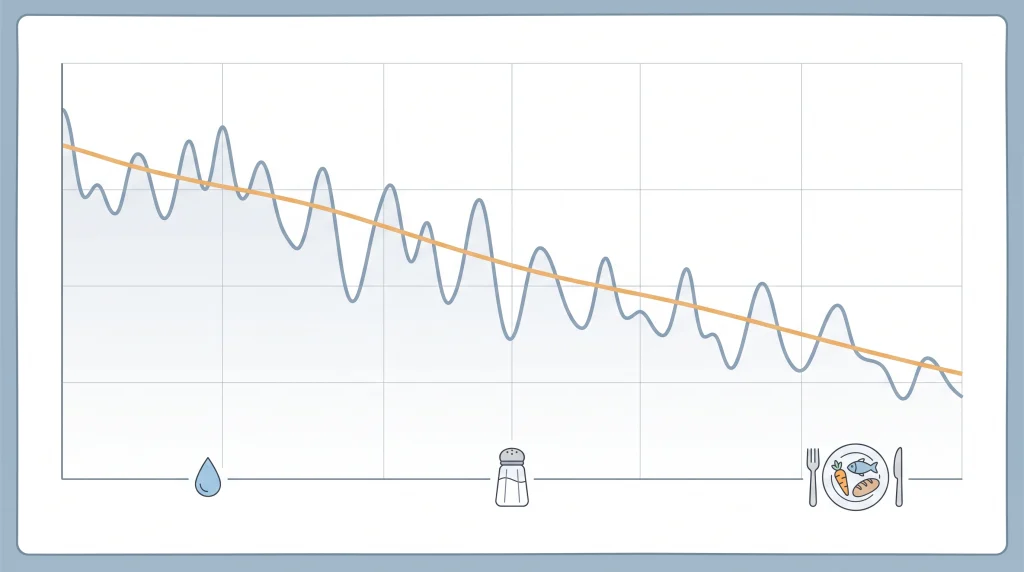
This is also why many people see a big drop in the first week. Much of it is water and glycogen, not fat. One high or low weigh-in doesn’t mean your plan is failing or working. Look at the trend over several weeks.
Is Losing More Than 2 Pounds a Week Always Unsafe?
Not always. Faster loss is common in the first week or two because of water, and people with a higher starting weight may lose faster early on. Some people also lose weight more quickly under medical supervision, for example on a medically managed very low-calorie diet, with prescription medication, or after weight-loss surgery.
The concern is deliberately chasing rapid weight loss on your own. NIDDK says losing weight very quickly may raise your risk of gallstones, and that very low-calorie diets can increase that risk. Extreme restriction can also leave you tired, short on nutrients, losing more muscle, and more likely to regain the weight. If you’re steadily losing much more than 2 pounds a week without trying to, or without supervision, talk to a healthcare professional.
How to Set a Realistic Weight Loss Goal
A good goal is specific, gradual and something you can control.
- Short-term goals (this week): habits, such as walking 20 minutes on five days or adding vegetables to dinner.
- Medium-term goals (1 to 3 months): a steady downward trend at about 1 to 2 pounds a week, or less.
- Long-term goals (6 months and beyond): NIDDK’s 5% to 10% of your starting weight is a sensible first milestone.
- Track trends, not single days. Weigh yourself under the same conditions and compare weekly or monthly averages.
- Drop all-or-nothing thinking. One off-plan meal or missed workout doesn’t undo your progress.
Choosing healthy weight loss plans or programs: look for ones that promote gradual loss, balanced eating, physical activity and long-term habits. Be wary of any program that promises very fast results, cuts out whole food groups without good reason, or relies on unproven supplements. NIDDK’s guide to choosing a safe and successful weight-loss program is a useful checklist.
Healthy Habits That Support Weight Loss
- Balanced meals built around vegetables, fruit, whole grains, lean proteins and fiber-rich foods.
- A moderate reduction in calories where needed, rather than extreme restriction. The right amount differs from person to person.
- Enough protein, which can help you feel full and protect muscle. Our guide to protein intake for weight loss covers how much you need.
- Regular physical activity, including strength training.
- Sleep and stress management, which make healthy choices easier.
- Consistent routines, such as regular meal times and planned workouts.
How Much Exercise Do You Need for Weight Loss?
The U.S. Physical Activity Guidelines recommend that adults get:
- At least 150 minutes a week of moderate aerobic activity, such as brisk walking, or an equivalent amount of vigorous activity
- Muscle-strengthening activity on at least 2 days a week

Some people need more activity than this to lose weight or to keep it off, and the right amount varies. Exercise supports weight management but doesn’t determine it on its own; nutrition plays a major role too.
If you’re new to exercise, start small and build gradually. Our weight loss workout plan for beginners gives you a four-week schedule, and the Beginner Fitness Guide walks through building a sustainable routine from scratch.
When Should You Talk to a Healthcare Professional?
Get professional advice if:
- you have a medical condition such as diabetes, heart disease or kidney disease
- you take medication that affects your weight or appetite
- you’re pregnant, breastfeeding or recently gave birth
- you have a history of an eating disorder, or you’re worried about your relationship with food
- you’re losing weight quickly without trying. MedlinePlus advises seeing a provider if you lose more than 10 pounds, or 5% of your body weight, over 6 to 12 months without knowing why.
- you’ve made sustained efforts for months without progress
- you’re unsure what weight-loss target is right for you
This article is general information, not medical advice.
FAQ
How much weight can you safely lose in a week?
For many adults, about 1 to 2 pounds (0.5 to 1 kg) a week is a commonly recommended safe pace, according to the CDC and NHS. Losing less than that is still healthy progress. In the first week you may lose more, mostly from water. If you keep losing much faster without trying or without medical supervision, check in with a healthcare professional.
Is losing 2 pounds a week healthy?
For many people, yes. Two pounds a week is at the top of the commonly recommended range, so treat it as a ceiling rather than a target. People with more weight to lose may reach it more easily than people closer to their goal.
How much weight can I lose in a month?
At a steady 1 to 2 pounds a week, that’s roughly 4 to 8 pounds (about 2 to 4 kg) over a month. Real progress is uneven, with bigger drops some weeks and plateaus in others. Look at your trend over several months, not one weigh-in.
How many kg can I lose in a week safely?
About 0.5 to 1 kg a week, which is the NHS guideline and the metric equivalent of the CDC’s 1 to 2 pounds.
Why did I lose weight quickly in the first week?
Mostly water. When you eat less, especially fewer carbohydrates, your body uses some of its stored glycogen, and the water stored with it is released. Fat loss happens more slowly, so expect a steadier pace after the first week or two.
Why has my weight loss slowed down?
The early water loss ends, a smaller body needs slightly less energy, and habits can drift over time. Short plateaus are normal. If progress stalls for several weeks, review your eating, activity and sleep, or talk to a professional.
Is losing weight faster always better?
No. Gradual loss is more likely to last, and rapid loss can raise risks such as gallstones, fatigue and muscle loss. Faster loss is sometimes appropriate under medical supervision, but it isn’t something to chase on your own.
What is the healthiest way to lose weight?
Gradually, through sustainable habits: balanced meals with enough protein and fiber, a moderate calorie reduction where needed, regular activity including strength training, good sleep, and consistency. Talk to a professional if you have health conditions.
Sources
- CDC: Losing Weight, on gradual loss of 1 to 2 pounds a week being more likely to last
- NIDDK: Choosing a Safe and Successful Weight-loss Program, on the initial goal of 5% to 10% of starting weight within 6 months
- NIDDK: Dieting and Gallstones, on rapid weight loss, very low-calorie diets and gallstone risk
- NHS: Obesity Treatment, on 0.5 to 1 kg (1 to 2 lb) a week
- HHS / ODPHP: Physical Activity Guidelines, Top 10 Things to Know, on 150 to 300 minutes of aerobic activity and two days of strength training
- MedlinePlus: Weight Loss, Unintentional, on when unexplained weight loss needs a provider visit
The claim that “even modest weight loss can bring health benefits” comes from the guidance your brief cites, but I didn’t re-open that exact CDC line today. Check it on the CDC page above before publishing.