
Key Takeaways
- Decide early whether you are buying outright or saving for a deposit on finance
- Set a specific car budget before you start saving — not after
- Automating your car savings removes the temptation to spend it elsewhere
- Cutting just two or three monthly expenses can shave months off your timeline
- A used car bought with cash beats a new car bought on credit almost every time financially
Saving up for a car is one of the most achievable short-to-medium term financial goals you can set. Unlike a house deposit, the numbers are smaller and the timeline is shorter — most people can reach a realistic car savings goal within 6 to 24 months with the right plan. Here is exactly how to do it.
Step 1: Decide What Kind of Car Purchase You Are Planning
Before you save a single dollar, you need to know what you are actually saving for. There are two very different approaches to buying a car and each one requires a different savings strategy.
Option 1 — Saving to buy a car outright with cash
This is the financially smartest option. You save the full purchase price, hand over the money, and own the car with zero debt and zero monthly payments. This works best for used cars in the $5,000–$20,000 range.
Option 2 — Saving a deposit for car finance
If you need a newer or more expensive car, you may be saving a deposit of 10–20% of the car’s value to reduce your monthly finance payments. In this case your savings goal is smaller but you will have ongoing monthly payments to budget for.
Decide which route you are taking before you start — it determines your exact savings target.
Step 2: Set Your Exact Car Budget
The biggest mistake people make when saving for a car is not setting a budget first. They save vaguely and then overspend when they get to the dealership.
How to set a realistic car budget
A common financial rule is to spend no more than 15–20% of your annual take-home income on a car purchase. Here is what that looks like in practice:
- Annual take-home income $30,000 → car budget $4,500–$6,000
- Annual take-home income $50,000 → car budget $7,500–$10,000
- Annual take-home income $70,000 → car budget $10,500–$14,000
Set your budget using this rule, research what cars are available in that price range in your area, and pick a specific target number. Vague goals produce vague results.
New car vs used car — what makes more financial sense
A new car loses 15–25% of its value the moment you drive it off the lot. A used car that is 2–4 years old has already taken that depreciation hit and is significantly cheaper for essentially the same vehicle. For most people saving on a budget, a reliable used car is the smarter choice every time.
Step 3: Build Your Car Savings Timeline
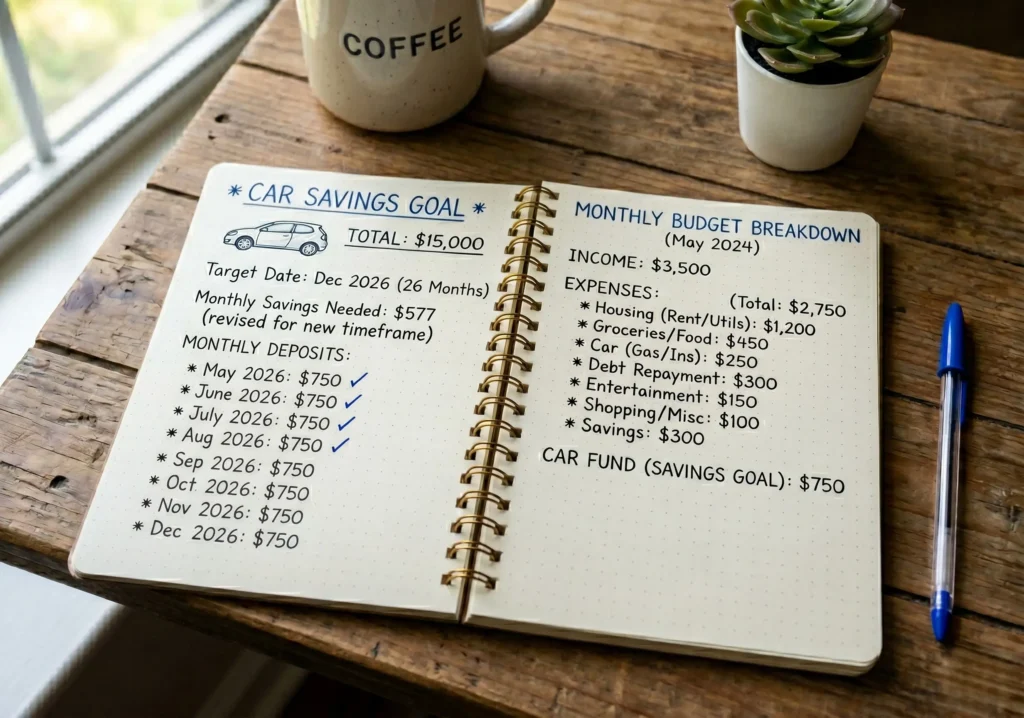
Once you have a target number, divide it by your monthly savings capacity to get your timeline.
Car savings timeline examples
- Target $5,000 · Saving $300/month → 17 months
- Target $5,000 · Saving $500/month → 10 months
- Target $10,000 · Saving $400/month → 25 months
- Target $10,000 · Saving $600/month → 17 months
- Target $15,000 · Saving $500/month → 30 months
- Target $15,000 · Saving $750/month → 20 months
If your timeline feels too long, the answer is either to increase your monthly savings amount, lower your car budget, or both. We will cover how to increase your monthly savings in the steps below.
Step 4: Open a Separate Car Savings Account
Just like saving for a house, keeping your car savings in a dedicated account is non-negotiable. When your savings sit in your everyday account, they get spent. Out of sight means out of reach.
What to look for in a car savings account
- A high-interest savings account to earn money while you save
- No or low fees that eat into your balance
- Easy to set up automatic transfers into
- Separate from your emergency fund and everyday spending
Name the account something specific like “Car Fund” — this psychological trick of labelling the account actually increases how consistently people save into it.
Step 5: Automate Your Car Savings Every Month
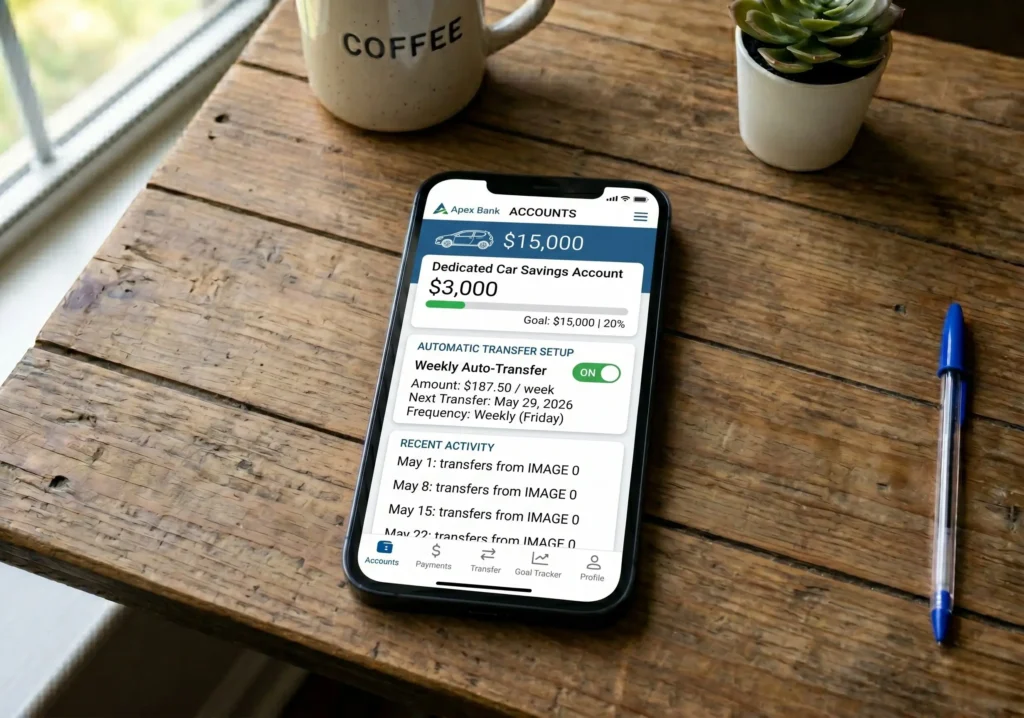
Automation is the most powerful savings tool available to you. Set up an automatic transfer from your main account to your car savings account on the same day your salary arrives — before you have a chance to spend it.
This is called paying yourself first. Instead of saving whatever is left at the end of the month, you save first and live on what remains.
How to set up automatic savings in 3 steps
- Log into your online banking
- Set up a standing order or automatic transfer to your car savings account
- Set the transfer date to 1–2 days after your salary payment date
- Set the amount to your monthly car savings target
Once it is automated, the saving happens without any willpower required.
Step 6: Free Up More Money Each Month
The faster you want to reach your car savings goal, the more you need to either cut spending or increase income. Here are the fastest ways to find extra money in your monthly budget.
Quick expenses to cut to save for a car faster
- Cancel streaming services you use less than once a week
- Cook at home instead of ordering takeaway — even two fewer orders per week saves $80–$120/month
- Switch to a cheaper phone plan — many people overpay by $20–$50/month on their mobile contract
- Pause any non-essential subscriptions until your car is paid for
- Sell items you no longer use — clothes, electronics, furniture, sports equipment
Ways to earn extra money toward your car fund
- Pick up weekend or evening freelance work
- Sell unwanted items on eBay, Facebook Marketplace, or Craigslist
- Offer a service in your neighbourhood — lawn mowing, car washing, dog walking, delivery driving
- Take on extra shifts or overtime at your current job
Even an extra $200 per month from selling unused items or a small side hustle can cut 4–6 months off your car savings timeline. For more ideas read our full guide on side hustle ideas for beginners
Step 7: Avoid These Car Saving Mistakes
These are the most common mistakes that derail people who are saving for a car.
Mistakes to avoid when saving for a car
- Buying more car than you budgeted for — dealerships are skilled at upselling
- Taking on high-interest car finance because you ran out of patience
- Forgetting to budget for insurance, road tax, and running costs on top of the purchase price
- Saving in an account with easy access — the easier it is to access, the more likely you are to dip in
- Not test driving several options before committing — buying the wrong car wastes the money you saved
Don’t forget the hidden costs of car ownership
The purchase price is just the beginning. Before finalising your car budget, factor in:
- Car insurance (can be $100–$300/month for new drivers)
- Fuel costs Annual registration and road tax
- Servicing and maintenance ($500–$1,500/year for a used car)
- Parking costs if applicable
Budget for these on top of your purchase price so there are no nasty surprises after you buy.
What to Do When You Have Hit Your Car Savings Goal
Once your savings account reaches your target — stop. Do not start spending immediately. Take two to four weeks to research the market properly, compare options, get independent inspections done on used cars, and negotiate the price down before agreeing to anything.
The best car buyers are patient buyers. Sellers — especially private sellers — will often drop the price by 5–10% for a buyer who is ready to pay immediately in cash.
Final Thoughts
Saving up for a car comes down to three things — a clear target, an automated system, and the discipline to leave the money alone until you reach your goal. None of it is complicated. The biggest obstacle for most people is simply starting.
Open your car savings account today and set up that first automatic transfer. Even $100 a month is a start. Momentum builds quickly once the habit is in place.
For more ways to free up money each month to put toward your car fund, read our guides on how to save money on groceries and how to save money for a house — the same budgeting principles apply across every savings goal.
Got a tip for saving for a car faster? Leave it in the comments — we read every one.
About the Author
James Carter writes about personal finance and smart money habits at GetWorldInfo.com. With over a decade of experience helping families budget smarter and cut everyday costs, James believes that saving money doesn’t require sacrifice — just the right strategy.