
Meta used Connect 2026 to show the device VR fans had been tracking for over a year under the codename Project Phoenix. It now has a plain, slightly awkward official name: Meta VR Glasses. It is not a Quest 4, and it is not a pair of Ray-Ban smart glasses. It is something in between, and that is why so many people are searching for it.
The short version: Meta calls it its most advanced device yet, launching in spring 2027 and weighing about 100 grams, and it goes on sale for $1,299.99 USD. Nobody outside Meta owns one yet. What follows separates what Meta has confirmed, what the press reported from Meta’s spec sheet and short demos, and what is still guesswork.
What Are Meta VR Glasses?
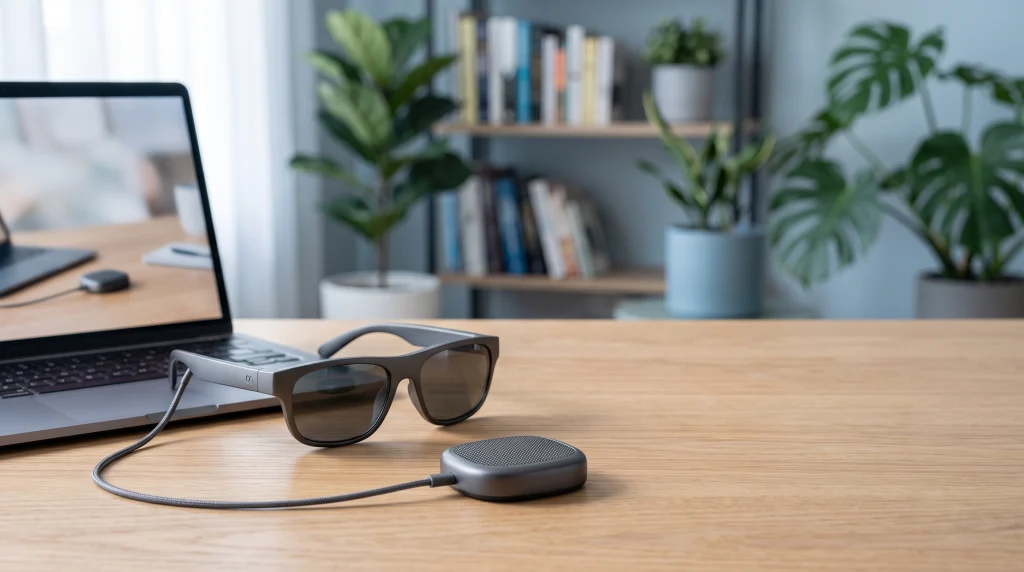
Meta VR Glasses are a lightweight virtual and mixed reality device from Meta, shaped like a pair of chunky glasses rather than a strapped headset. The glasses hold the displays and sensors, while a separate pocket-sized compute puck handles processing, battery and storage. You control them mainly with your eyes and hands, and they run Meta Horizon OS.
Meta’s developer site describes them as lightweight glasses paired with a compact compute puck, running Meta Horizon OS, taking input from eyes, hands and voice. Unity’s documentation puts it even more simply: the glasses are tethered to a compute puck, have built-in eye tracking, and treat eyes and hands as the primary input.
The naming causes real confusion, so here is the lineup as it stands:
- Meta Quest 3 and Quest 3S: all-in-one headsets with everything strapped to your head and controllers in the box.
- Ray-Ban Meta glasses: camera and audio smart glasses with Meta AI. No VR at all.
- Meta Ray-Ban Display: smart glasses with a small heads-up display for notifications and quick info. Not immersive.
- Meta VR Glasses: full VR and passthrough mixed reality in a glasses-style frame, with the computer moved into your pocket.
Why Meta Is Moving From Headsets to Glasses
VR has never had a content problem so much as a wearing problem. Headsets are heavy, front-loaded and warm, and after an hour most people want them off. Meta’s answer is to stop putting the computer on your face.
According to Meta, the glasses are five times lighter than Quest 3, mostly thanks to the two-part design, with the glasses handling sensors and display while the puck handles compute, battery and storage.
That trade is the whole product. You get a much lighter thing on your head, and in exchange you carry a second object and a cable. My read is that this is a sensible bet for watching films, working and casual games, and a harder sell for anyone who loves thrashing around in a room-scale shooter. We’ll know which camp wins once reviewers get full units.
Meta VR Glasses Features
Eye Tracking
Eye tracking is how you point. Meta’s developer guide says gaze is the primary way to target things, with a hand pinch as the primary way to select. In practice that means you look at a button and pinch your fingers; no laser pointer, no hunting with a controller.
Why that matters day to day: it is the difference between using a menu and fighting one. Anyone who has tried to click a tiny “X” with a wobbly controller ray will understand. It is also the same interaction model Apple uses on Vision Pro, so it has been proven workable.
The spec sheet reported by Road to VR lists four eye tracking cameras, two per eye, and iris detection for biometric authentication, which suggests you’ll be able to unlock the device just by putting it on. One caveat from early demos: Road to VR’s reporter noted eye tracking appeared to be used only for interface tasks for now. Whether Meta uses it to render sharper detail only where you are looking (a technique called foveated rendering) hasn’t been confirmed.
Hand Tracking and Natural Interaction
Meta VR Glasses don’t come with controllers. Meta’s own pitch is that you look to target, tap to select and talk to Meta AI with no controllers required.
The gestures are small. Per Road to VR, you look to highlight, pinch to select, and rub your thumb up, down or sideways to scroll, much like Meta Ray-Ban Display. Extra cameras help: the reported sensor setup includes front and downward-facing cameras for a wider hand tracking range, so your hands don’t need to hover in front of your face.
Controllers are still an option. Meta confirms that Touch Plus controllers are supported for access to the full Quest library, sold separately, and you can use the pair from an existing Quest 3 or 3S. For typing, Meta is adding Surface Keyboard, which turns a flat surface into a keyboard and trackpad, plus support for Bluetooth keyboards and gamepads.
Lightweight Design
About 100 grams is roughly the weight of a heavy pair of sunglasses plus change. For comparison, a Quest 3 sits well above 500 grams.
The frame is magnesium alloy for rigidity and cooling, and the sides are open. Meta says the open sides and passthrough cameras keep you aware of your surroundings, so you can watch a full movie or work on a private screen during a flight. For full immersion there are optional light blockers.
A few practical details that matter for fit:
- Lenses adjust for IPD (the distance between your pupils) from 56 to 70mm, and prescription inserts will come from Zenni Optical.
- They come in two sizes, sold as separate SKUs, so getting the right one will matter more than it does with a strap.
That second point is easy to overlook. A glasses fit is less forgiving than a head strap, and one early hands-on report noted the smaller size pinched at the sides. Try before you buy, if you can.
The Compute Puck
The puck is where the actual computer lives. Road to VR reports it weighs around 300g and holds Qualcomm’s Snapdragon Reality Elite chip (XR2 Gen 3) and a battery rated for 3+ hours of mixed use; it can charge during use from the included 45W USB-C adapter. It links to the glasses with an optical tether and clips to a pocket or bag.
Storage is 128GB, expandable up to 1TB through a microSD slot on the puck.
Three hours is enough for a feature film, and not a lot more. Being able to plug in while you wear it helps on a desk or a plane seat, less so on a sofa across the room from the socket.
Meta Horizon OS and Software
This is the quietly important part. The glasses run the same operating system as Meta Quest, so engines, SDKs and developer workflows carry over. For buyers, it means the existing Quest store is there on day one rather than a brand-new, empty app catalog.
There are limits. Meta’s developer docs say apps must be 64-bit; a binary with only 32-bit native libraries won’t run on the glasses even if it runs on another Quest. Some older titles could therefore be missing unless developers update them.
Developers can start now. The v207 SDKs for Unity, Unreal, Android and Web are available ahead of the spring 2027 hardware launch, and Meta XR Simulator and Spatial Simulator let them test Meta VR Glasses input on a computer.
How Meta VR Glasses Could Change Gaming
Gaming is where the design makes the most compromises, and it’s worth being honest about that.
On the plus side, Meta promised more than 75 games and apps optimized for hand gestures, with a hand-tracking version of Beat Saber, Dragon Grove, Phoenix Wright: Ace Attorney, Dual Destinies, and a hand-tracked Tetris Effect among the headliners. That list tells you the intended flavor: rhythm, puzzles, narrative and casual play.
The catch is field of view, meaning how much of the virtual world you see at once. The reported spec is about 70° horizontal by 66° vertical, around 88° diagonally, compared with roughly 110° horizontally on Quest 3. UploadVR said the narrower view makes the device feel much less immersive than a Quest when the light blockers are attached.
My take: the glasses will likely be a very good casual gaming device and a compromised action gaming device. If fast, sweaty VR is your main hobby, Quest 3 isn’t going anywhere, and it’s cheaper.
There’s another route for gamers. The reported spec sheet includes native DisplayPort input, letting you wire directly into laptops, consoles and handhelds. A giant private screen for a handheld PC is a genuinely appealing use.
Meta VR Glasses for Movies, Entertainment and Productivity
This is the category Meta designed for, and the display specs show it. The glasses use micro-OLED panels at 2,412 x 2,288 pixels per eye and 37 pixels per degree, well above Quest 3’s 25. Pixels per degree is the useful number: it describes how sharp things look, and higher means text and film detail hold up better.
For film fans, Road to VR reports IMAX Enhanced certification plus Dolby Vision and Dolby Atmos, with select films viewable in IMAX’s expanded aspect ratio. Streaming support at launch is said to include Disney+ and Peacock (both with 3D), HBO, YouTube and Prime Video, with other services reachable via the browser.
Productivity is the other pillar. The device supports wireless multi-screen desktop streaming from a Mac, PC or phone. The practical picture is a laptop user on a train or plane who wants three large monitors without anyone reading over their shoulder.
Video calls get an upgrade too. Meta says people appear as holograms with spatial audio, callers on phones or computers see your hologram too, and it works with apps from WhatsApp to Zoom Workplace. How natural these avatars feel will only become clear with longer use.
Meta VR Glasses vs Meta Quest
Meta is explicit that this isn’t a Quest replacement: the company sees VR Glasses as an addition to Meta Quest devices, not a replacement.
| Meta VR Glasses | Meta Quest 3 | |
|---|---|---|
| Design | Glasses plus tethered puck | All-in-one headset |
| Weight on head | About 100g | Roughly five times heavier |
| Main input | Eyes and hands | Controllers and hands |
| Controllers | Supported, sold separately | Included |
| Field of view | About 70° horizontal (reported) | Roughly 110° horizontal |
| Sharpness | 37 PPD (reported) | 25 PPD |
| Software | Meta Horizon OS, Quest store | Meta Horizon OS, Quest store |
| Price | $1,299.99 (US) | Much cheaper |
The simplest way to think about it: Quest is the better VR games machine; Meta VR Glasses aim to be the more comfortable screen for everything else.
Meta VR Glasses Release Date
Meta has only committed to a season. The glasses go on sale in spring 2027, and VR.org notes there are no preorders and no date more specific than the season.
Availability is planned to be broad. Road to VR lists supported launch regions including the US, UK, Canada, Mexico, much of Western and Northern Europe, Japan, Taiwan, Korea, Singapore, Australia and New Zealand. Treat that list as a plan, not a guarantee, until sales open.
How Much Will Meta VR Glasses Cost?
Unlike most pre-launch hardware, the price is official: $1,299.99 in the US. Reporting indicates the price covers the glasses, the puck and a 45W charger, with controllers extra.
What isn’t confirmed yet: prices outside the US, the cost of controllers bought separately, and final pricing for prescription inserts. Also, UploadVR reports that some retailers will offer a bundle with controllers included, but Meta hasn’t detailed that.
For context, VR.org noted that in June 2025 the Wall Street Journal reported an internal hope of pricing below $1,000. That didn’t happen, likely tied to rising chip and memory costs across the industry.
Who Are Meta VR Glasses For?
Based on what Meta has shown, the best fit looks like:
- Frequent travelers who want a private big screen for films or work.
- Laptop users who’d like multiple virtual monitors without carrying any.
- People who gave up on VR because headsets felt heavy or claustrophobic.
- Developers who want their apps ready for Meta’s next platform.
Probably not ideal for people who mainly play fast-paced VR games, anyone on a tight budget, or kids and families sharing one device (two sizes and a glasses fit make sharing less simple than a strap).
What We Still Don’t Know
Plenty, honestly. The open questions worth watching:
- The exact launch date and when preorders open.
- How comfortable the glasses are over several hours, since Connect demos were short.
- Real battery life in games, as opposed to media playback.
- Whether eye tracking will enable foveated rendering or stay limited to the interface.
- How many existing Quest apps will work well without controllers at launch.
- Wireless specs; Road to VR’s sheet lists Wi-Fi and Bluetooth generation as still to be determined.
- Regional pricing, and whether retailer controller bundles become widespread.
Are Meta VR Glasses the Future of VR?
Calling them “VR glasses” is both accurate and a little misleading. They can do fully immersive VR with the light blockers on, but the open design and passthrough cameras point toward something closer to lightweight spatial computing: digital screens and apps layered over the room you’re sitting in. UploadVR made a fair point that the device may shine more in passthrough mixed reality, where seeing your periphery is often better than darkness.
The bigger shift is architectural. Splitting the computer from the display is how you eventually get something light enough to wear for hours, and Meta clearly believes comfort will matter more to most buyers than raw immersion. Whether that’s right is a question only spring 2027 buyers can answer. It is, at the very least, the clearest sign yet of where Meta wants VR hardware to go.
FAQs
What are Meta VR Glasses?
They’re Meta’s glasses-style VR and mixed reality device. The glasses weigh about 100 grams and connect to a pocket compute puck that handles processing, battery and storage. Eyes and hands are the main controls.
When will Meta VR Glasses be released?
Meta says spring 2027. No specific date or preorder window has been announced.
How much will Meta VR Glasses cost?
$1,299.99 in the US. Controllers are sold separately, and international pricing hasn’t been confirmed.
Are Meta VR Glasses replacing Meta Quest?
No. Meta describes them as an addition to the Quest line. They run the same operating system and store, but Quest remains the more immersive, controller-first option.
Do Meta VR Glasses use controllers?
Not by default. You look at items and pinch to select. Touch Plus controllers are supported for games that need them, including the ones from a Quest 3 or 3S.
Can I wear my glasses with Meta VR Glasses?
Prescription inserts from Zenni Optical are planned, and the lenses adjust for a range of pupil distances.
What’s the difference between Meta VR Glasses and Ray-Ban Meta glasses?
Ray-Ban Meta glasses are everyday smart glasses with a camera, audio and Meta AI, but no VR. Meta VR Glasses are a full virtual and mixed reality device with high-resolution displays and a separate compute puck.
Sources
- Introducing Meta VR Glasses, A New Era for Virtual Reality (Meta)
- Start building for Meta VR Glasses (Meta Horizon OS Developers)
- Meta Connect 2026 developer recap (Meta for Developers)
- Get started with Meta VR Glasses (Meta Horizon OS Developers)
- Bring your app to Meta VR Glasses (Meta Horizon OS Developers)
- Develop for Meta VR Glasses (Unity Documentation)
- Meta Announces ‘VR Glasses’ Next-Gen XR Headset, Priced at $1,300 (Road to VR)
- Meta VR Glasses Hands-on (Road to VR)
- Meta VR Glasses Officially Announced (UploadVR)
- Meta VR Glasses: $1,299.99, Spring 2027 (VR.org)