Every autumn, coffee shops fill their windows with signs about free cups, and social feeds fill up with latte photos. That’s National Coffee Day, an unofficial American holiday that has become one of the busiest days on the coffee calendar. It is part celebration, part marketing event, and for most people, a good excuse to try something new or finally visit the café they keep walking past.
This guide covers when it is, where it came from (the honest answer is messier than most websites admit), how it differs from International Coffee Day, and practical ways to mark it.
When Is National Coffee Day?
National Coffee Day is observed every year on September 29 in the United States. In 2026 it fell on Tuesday, September 29. In 2027 it lands on a Wednesday, and in 2028 on a Friday.
The date is fixed, so it never moves around like Thanksgiving. Canada marks a coffee day on September 29 too, but many other countries use different dates, which is where things get confusing. More on that below.
If you missed it this year, International Coffee Day arrives just two days later, on Thursday, October 1, 2026.
What Is National Coffee Day?
It is an informal observance celebrating coffee and the people who make it. Nobody gets the day off, and it isn’t recognized by Congress. It lives mostly in cafés, grocery aisles and company promotions.
For most Americans, the day shows up as deals: free or discounted cups from chains, bonus loyalty points and cheap bags of beans. Underneath that, some coffee organizations use the date to talk about growers, pricing and sustainability, which are easy topics to forget when you’re just grabbing a drink on the way to work.
The History of National Coffee Day
Here’s the honest part: nobody has a clean, well-documented origin story for National Coffee Day.
Several versions circulate online:
- The National Coffee Association version. Many holiday sites say the National Coffee Association, the main US coffee trade group, promoted the first official day around 2005. That claim is repeated widely, but it’s hard to find a primary source from the NCA itself confirming it.
- The New Orleans version. Another account says the day truly took off in 2009, when the Southern Food and Beverage Museum in New Orleans tied “Coffee Day” to its first New Orleans Coffee Festival. Even here, accounts disagree on the details; one history says the festival itself was held on October 3, 2009.
- The 1723 shipment story. Some sites say September 29 marks the anniversary of the first coffee shipment from Brazil to the United States in 1723. That one doesn’t hold up well, since the United States didn’t exist yet in 1723, and there’s no strong documentation for it.
What is clear is that the day gathered steam around 2009 and the years after, as chains began using it for promotions and social media gave it a hashtag to rally around. By 2013, the NCA was publicly promoting September 29 as National Coffee Day on social media.
Coffee’s own history is far older and far better documented. The earliest credible evidence of coffee drinking points to Sufi monasteries around Mokha in Yemen in the middle of the 15th century, with the plant originally coming from Ethiopia. From there it spread to Europe, Asia and eventually the Americas.
National Coffee Day vs. International Coffee Day
These two get mixed up constantly, and for good reason: they’re two days apart and both involve free coffee.
| National Coffee Day | International Coffee Day | |
|---|---|---|
| Date | September 29 | October 1 |
| Where | Mainly the United States (Canada also uses Sept 29) | Worldwide |
| Organized by | No single official organizer | International Coffee Organization |
| Official status | Informal observance | Designated by the UN in 2026 |
| Main focus | Celebrating coffee, promotions | Coffee culture plus growers and sustainability |
International Coffee Day has a much clearer paper trail. Member states of the International Coffee Organization agreed in March 2014 to create a single worldwide coffee day on October 1, and the first official celebration launched in Milan as part of Expo 2015. When it launched, 74 ICO member states and 26 coffee associations signed on.
There’s a newer development too. In March 2026, the United Nations formally designated October 1 as International Coffee Day, giving it an official global status that National Coffee Day doesn’t have.
Is National Coffee Day Celebrated Worldwide?
Not under that name or on one date. Before 2015, countries marked coffee on widely varying dates; Brazil, for example, has held its national coffee day on May 24. Japan has held a coffee day since 1983. If you’re outside the US, it’s worth checking your own country’s date rather than assuming September 29.
How Do People Celebrate National Coffee Day?
Most celebrations are small, which is part of the charm. A few that actually make the day feel different from a regular Tuesday:
Go somewhere new. Plenty of people drink coffee from the same place for years. National Coffee Day is a low-stakes reason to try the independent café on the other side of town, or order something off the menu you’ve never tried.
Buy beans from a local roaster. A bag of freshly roasted beans from a small roaster usually lists the country, sometimes the farm, and tasting notes. It’s a simple way to connect with where coffee comes from.
Make it social. Coffee has always been an excuse to sit down with someone. Bring a carrier of coffee to work, or invite a friend for a proper café visit instead of a drive-through run.
Learn one thing. Watch a barista pull a shot, read about how a coffee is processed, or ask your café what they’re brewing and why.
Popular Coffee Drinks to Try on National Coffee Day
Most café menus are built from a few basic ingredients: espresso, water, milk and ice. Here’s what separates the common drinks.
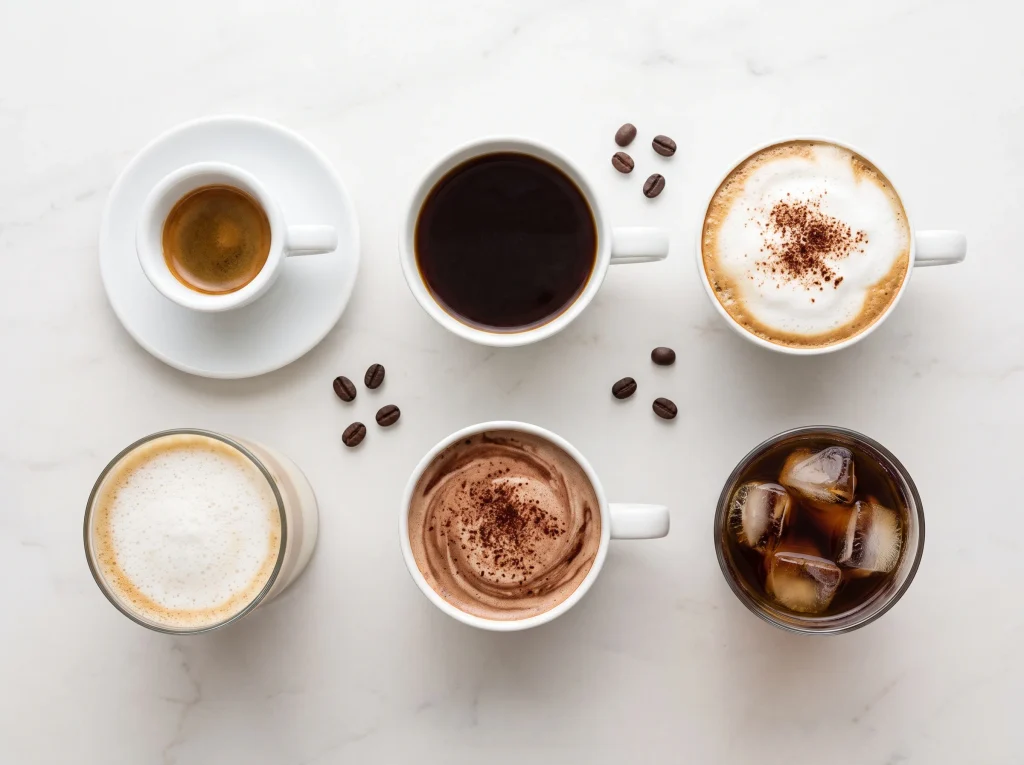
- Espresso: A small, concentrated shot made by forcing hot water through finely ground coffee under pressure. It’s the base for most café drinks.
- Americano: Espresso topped with hot water. It’s closer in strength and feel to drip coffee but with espresso’s flavor.
- Cappuccino: Espresso with steamed milk and a thick layer of foam. Traditionally smaller and more foam-forward than a latte.
- Latte: Espresso with plenty of steamed milk and a thin layer of foam. Milder and creamier.
- Flat white: Similar to a latte, but usually smaller with a thinner, velvety milk texture, so the coffee comes through more.
- Mocha: A latte with chocolate. Dessert and caffeine in one cup.
- Cold brew: Coffee grounds steeped in cold water for many hours, then strained. Smooth and low in bitterness.
- Iced coffee: Usually hot-brewed coffee that’s cooled and poured over ice. Brighter and more acidic than cold brew.
If you normally drink drip coffee, a flat white or a straight espresso is a good way to taste the coffee itself. If you want something festive, a mocha is hard to argue with.
Interesting Coffee Facts
Some real numbers from the National Coffee Association’s long-running research:
- Coffee beats water. The NCA’s 2026 Fall report found 66% of American adults drank coffee in the past day, more than any other drink, including tap or bottled water.
- Specialty coffee has overtaken the regular stuff. 48% of adults had specialty coffee (lattes, cappuccinos and similar) in the past day, a record high.
- Most coffee is still made at home. 83% of past-day coffee drinkers had coffee at home, even as café visits climbed back toward pre-pandemic levels.
- Iced coffee is growing. In the summer survey, 21% of past-day drinkers had cold coffee, up from 16% in 2022.
- The data goes way back. The NCA has been surveying American coffee habits since 1950, making it the longest-running study of its kind.
That home-brewing number is worth sitting with. For all the attention cafés get, the everyday coffee ritual in America is mostly a kitchen counter and a mug.
National Coffee Day Deals and Free Coffee
Promotions are the most searched part of the day, and 2026 was no exception. Major news outlets tracked dozens of offers from chains like Dunkin’, Krispy Kreme, Panera and others.
A few verified examples from 2026:
- Dunkin’ gave rewards members a free medium hot or iced coffee with any purchase in the app.
- Peet’s Coffee brought back a throwback price: a medium drip coffee for 25 cents, one day only.
- Circle K offered rewards members a free medium coffee at its 7,000 locations through its app.
Most of these were one-day deals and have ended. One that runs longer: Dairy Queen’s small Coffee Cooler for $3 at participating US locations through November 1.
For next year, a few tips for finding legitimate deals:
- Download apps early. Most freebies now require a loyalty account, and signing up on the day can be slow.
- Check trusted roundups. TODAY, Food Network and local news outlets publish verified lists in the days before September 29.
- Read the fine print. “Free” often means with a purchase, and some deals exclude cold brew or larger sizes.
- Don’t forget independents. Local cafés sometimes run their own offers on social media that never make the big lists.
How to Celebrate National Coffee Day at Home
You don’t need a café to make the day feel special. A few ideas that are actually worth the effort:
Try one new brewing method. A pour-over cone or a French press costs very little and makes a noticeably different cup from an automatic drip machine. A French press gives a heavier, fuller body; pour-over tends to be cleaner and brighter.
Grind your beans fresh. Pre-ground coffee loses its aroma quickly. Grinding right before brewing is probably the single biggest upgrade most home setups can make.
Make cold brew overnight. Mix coarsely ground coffee with cold water, leave it in the fridge for around 12 to 18 hours, then strain. You’ll have smooth coffee concentrate for days.
Host a small tasting. Buy two or three bags from different countries, brew them the same way, and compare. It’s surprisingly easy to taste the differences once they’re side by side, and it turns a cup of coffee into an evening with friends.
Attempt a café drink. Heat and froth milk with a handheld frother or a jar with a lid (shake it, then microwave briefly), and pour it over strong coffee for a homemade latte.
Why Coffee Has Such a Strong Place in Culture
Coffee has always been about more than caffeine. The first coffeehouses were gathering places, and in 17th and 18th century England they were nicknamed “penny universities” because a cheap cup came with conversation, news and debate.
That social role never really disappeared. Coffee is how people meet a new colleague without the pressure of a meal, how friends catch up, and how many people signal the start of their workday. Offering someone a cup is a small act of hospitality in homes all over the world, with each culture putting its own spin on it, from Italian espresso bars where you drink standing up to Ethiopian coffee ceremonies where roasting and brewing happen in front of guests.
National Coffee Day is mostly commercial, sure. But the reason it works at all is that coffee is already woven into daily routines. The promotions just give people a reason to notice something they do every day.
A thoughtful way to spend the day: pay a little attention to the cup in front of you. Where did it come from, who roasted it, and how would it taste made a different way? That’s enough of a celebration.
Frequently Asked Questions About National Coffee Day
When is National Coffee Day?
September 29 every year in the United States. In 2027 it falls on a Wednesday.
Why do we celebrate National Coffee Day?
To celebrate coffee and coffee culture. In practice, it’s also a big promotional day for coffee chains, and some organizations use it to highlight coffee growers and sustainability.
Is National Coffee Day the same as International Coffee Day?
No. National Coffee Day is a US observance on September 29. International Coffee Day is a worldwide observance on October 1, organized by the International Coffee Organization and recognized by the UN.
Who started National Coffee Day?
It isn’t clear. The National Coffee Association is often credited with starting it around 2005, and a 2009 New Orleans coffee festival is often cited as the moment it took off, but neither story is firmly documented.
Are there free coffee deals on National Coffee Day?
Usually, yes. Many chains offer free or discounted coffee, mostly through loyalty apps. Deals change every year, so check verified roundups a few days before September 29.
How can I celebrate National Coffee Day at home?
Try a new brewing method, grind beans fresh, make cold brew, or host a small tasting with a few different coffees.
Is National Coffee Day celebrated outside the United States?
Canada also marks September 29, but most countries have their own coffee days on different dates, and many celebrate International Coffee Day on October 1.
Sources
- National Coffee Data Trends Fall Report 2026 (NCA, via PR Newswire)
- U.N. Officially Designates Oct. 1 International Coffee Day (Daily Coffee News)
- First official International Coffee Day (International Coffee Organization)
- International Coffee Day (Wikipedia)
- National Coffee Day (National Day Calendar)
- National Coffee Day vs International Coffee Day history
- National Coffee Day 2026 deals (LiveNOW from FOX)
- National Coffee Day 2026 deals (Times Union)
- National Coffee Day 2026 deals (Daily Voice)
- International Coffee Day (Holiday Insights)
- National Coffee Day (National Today)