
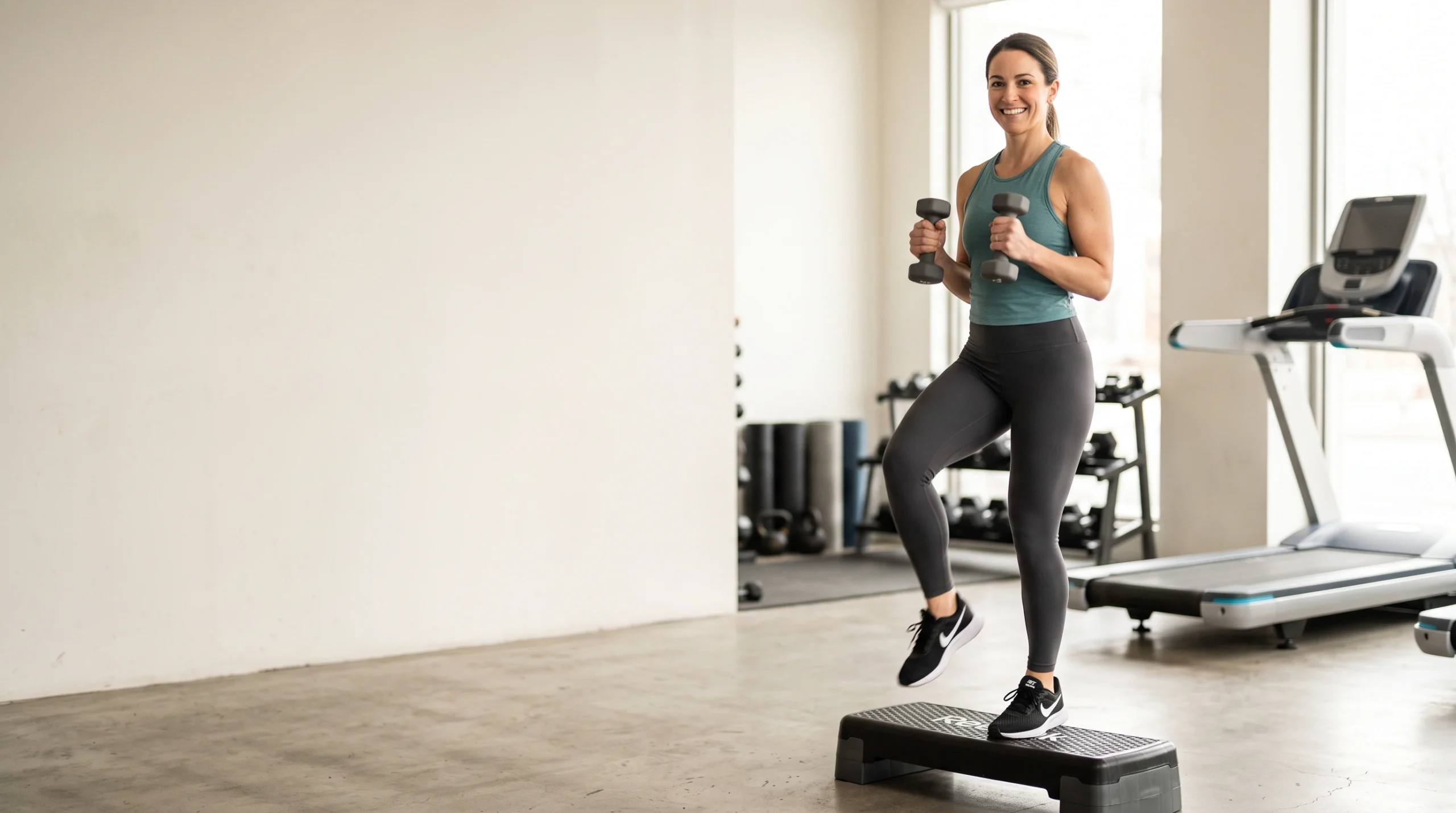
A good weight loss workout plan for beginners isn’t the hardest one you can find. It’s the one you can still follow in week six. That usually means three to five days of movement a week, mixing walking or other cardio with two short strength sessions, and adding a little more time or effort every week instead of going all out from day one. The 4-Week Beginner Workout Plan: Think of it as a short weight loss training program you can repeat or build on
Exercise also works best alongside food, sleep and daily activity. A workout plan can support weight loss, but it can’t guarantee a number on the scale. Its job is to build a habit you can keep. The guide below gives you a four-week starting framework, a sample weekly schedule, and options for home, the gym, outdoor walking and the treadmill.
What is a good weight loss workout plan for beginners?
A good beginner plan combines moderate cardio, like brisk walking, on most days with full-body strength training at least two days a week, plus rest days. Start with short sessions, increase time or effort gradually over several weeks, and choose activities you can repeat consistently alongside healthy eating and sleep.
What Makes a Good Beginner Weight Loss Workout Plan?
Most people who quit a new exercise routine don’t quit because it was too easy. They quit because it hurt, took too long, or didn’t fit their week. A solid weight loss exercise plan solves those problems first.
Consistency beats intensity
The U.S. Physical Activity Guidelines recommend that adults work toward 150 to 300 minutes of moderate aerobic activity per week, plus muscle-strengthening activity at least two days a week. They also say any amount of activity has some health benefit, and that you don’t need to exercise in 10-minute blocks for it to count. For a beginner, that means a 10-minute walk after dinner is real progress, not a waste of time.
Build gradually
Jumping straight into hour-long, high-intensity sessions is the quickest way to end up sore, tired or injured. Raising your time or effort a little each week gives your joints, muscles and energy levels time to adapt.
Mix cardio and strength
Cardio raises your heart rate and helps you build endurance. Strength training works your muscles against resistance. A sensible beginner program includes both, because they do different jobs (more on that below).
Count daily movement
Steps around the house, taking the stairs and short walks during the day all add to your activity. The guidelines’ core message for adults is to “move more and sit less.”
Plan your recovery
Rest days aren’t a sign of weakness. They’re when your body adapts to the work you’ve done. Most beginners do well with at least one or two full rest days a week, and some easier days in between.
Keep expectations realistic
The CDC says people who lose weight gradually and steadily, about 1 to 2 pounds a week, are more likely to keep it off than people who lose it faster. If you want to understand what a healthy rate of weight loss looks like, read that first, then judge your progress over months rather than days.
How Hard Should Beginner Workouts Feel?
You don’t need a heart-rate monitor to start. Two simple checks work well:
- The talk test. During moderate cardio, you can talk in full sentences but couldn’t comfortably sing. If you can only get out a few words between breaths, you’re working at a vigorous level.
- A 1 to 10 effort scale. Most beginner sessions should feel around 5 to 6 out of 10. For strength exercises, stop each set when you feel you could still do two or three more good reps.
Sharp or joint pain is not a sign the workout is “working.” Stop that exercise and try an easier version, or skip it for the day.
The 4-Week Beginner Workout Plan
This 4 week workout plan for weight loss uses three kinds of sessions:
- Cardio: brisk walking outdoors, treadmill walking, a stationary or outdoor bike, or an elliptical.
- Strength: a short full-body routine (see Workout A and Workout B below).
- Recovery: rest, gentle stretching or an easy stroll.
All the times are ranges, not requirements. If week one’s numbers feel like too much, repeat that week before moving on.
Week 1: Build the habit
- Cardio: 3 sessions of 15 to 20 minutes at an easy-to-moderate pace
- Strength: 2 sessions, 1 set of 8 to 10 reps of each Workout A exercise
- Mobility: 5 minutes of gentle stretching after each session
- Rest: at least 2 full rest days
Your goal this week is simply to show up on the days you planned. Use the easiest versions of each exercise and focus on learning how they should feel.
Week 2: Increase consistency
- Cardio: 3 sessions of 20 to 25 minutes at a moderate pace
- Strength: 2 sessions, 2 sets of 8 to 10 reps. Alternate Workout A and Workout B.
- Daily movement: add a short walk on one rest day if you feel good
- Rest: at least 1 to 2 full rest days
Raise only one thing at a time. If your cardio sessions get longer, keep your strength sessions the same, and the other way round.
Week 3: Add progression
- Cardio: 3 to 4 sessions of 25 to 30 minutes. On one of them, try a few 1-minute stretches of faster walking or pedaling, followed by 2 minutes of easy recovery.
- Strength: 2 sessions, 2 sets of 10 to 12 reps. If 12 reps feel easy, move to a slightly harder version of the exercise (for example, a lower incline push-up) or use slightly heavier weights.
- Rest: at least 1 full rest day
Good form still comes first. A harder exercise done with poor technique is a step backward.
Week 4: Build a sustainable routine
- Cardio: 3 to 4 sessions of 25 to 35 minutes, including one longer, easy walk on the weekend
- Strength: 2 to 3 sessions of 2 to 3 sets, alternating Workout A and Workout B
- Optional: swap one cardio session for a beginner circuit (see below)
- Rest: at least 1 full rest day
By the end of week four, many beginners are close to 100 to 140 minutes of cardio a week, plus two strength sessions. That puts you well on the way toward the 150-minute guideline. If it takes you eight weeks instead of four to get there, that’s fine.

Sample Weekly Workout Plan for Weight Loss (Week 4)
This shows how one week can look once the routine settles in. Move the days around to fit your schedule.
Monday: Strength (Workout A)
- Intensity: moderate, effort 5 to 6 out of 10
- Easier option: do 1 to 2 sets instead of 3
Tuesday: Brisk walk, 25 to 35 minutes
- Intensity: moderate (you pass the talk test)
- Easier option: split it into two 15-minute walks
Wednesday: Rest or recovery
- Intensity: very light
- Option: gentle stretching or an easy 10 to 15 minute stroll
Thursday: Strength (Workout B)
- Intensity: moderate
- Easier option: use bodyweight versions instead of weights
Friday: Cardio of choice, 25 to 35 minutes
- Intensity: moderate
- Options: stationary bike, treadmill, elliptical or a beginner circuit
Saturday: Longer easy walk, 30 to 45 minutes
- Intensity: easy to moderate
- Easier option: 20 to 30 minutes on flat ground
Sunday: Rest
- Fully off, or just your normal daily movement

The Strength Workouts
Both workouts are full-body routines. Do each exercise for the sets and reps listed in that week of the plan, resting 60 to 90 seconds between sets.
Workout A
- Bodyweight squat (easier: sit down onto a chair and stand back up)
- Wall or incline push-up (hands on a wall, kitchen counter or sturdy bench)
- Glute bridge
- Resistance band or dumbbell row
- Plank on knees or forearms, held for 15 to 30 seconds
Workout B
- Step-ups onto a low, stable step
- Seated or standing dumbbell shoulder press (light weights)
- Supported split squat (hold a chair or wall for balance)
- Band pull-apart or band row
- Bird dog, 6 to 8 slow reps per side
Best Exercises for Beginners Trying to Lose Weight
No single exercise burns the most fat for everyone. The best full-body weight loss exercise is one you can do safely and regularly. These are good places to start:
- Walking and brisk walking: low impact, free and easy to scale. Brisk walking is the guidelines’ go-to example of moderate activity.
- Treadmill walking: the same benefits, plus control over speed and incline in any weather. If you mostly walk indoors, read our guide to treadmill walking for weight loss.
- Cycling: easy on the knees and hips, outdoors or on a stationary bike.
- Bodyweight squats: work the thighs and glutes, and practice a movement you use every time you stand up.
- Glute bridges: strengthen the glutes and back of the legs with very little strain on the knees.
- Step-ups: build leg strength and balance, and you can use your home stairs.
- Wall and incline push-ups: train the chest, shoulders and arms. The higher your hands, the easier they are.
- Resistance-band exercises: cheap, portable, and easy to make lighter or harder.
- Dumbbell exercises: let you add load gradually as you get stronger.
- Beginner circuit training: several exercises done back to back with short rests, so you train strength and get your heart rate up in the same session.
Cardio vs Strength Training: Which Should Beginners Do?
Do both. They do different jobs.
Cardio keeps your large muscles moving rhythmically for a sustained period. It raises your heart rate, builds endurance, and burns energy while you’re doing it. Walking, cycling, swimming and dancing all count.
Strength training makes your muscles work against resistance from bodyweight, bands, dumbbells or machines. The American College of Sports Medicine’s position stand on weight loss notes that resistance training on its own doesn’t usually produce much weight loss, but it can help you keep or build lean mass and improve the ratio of fat to lean mass. In daily life, that means carrying, climbing and getting up from the floor all become easier.
The same position stand associates roughly 150 to 250 minutes of moderate activity per week with modest weight loss, and more activity with larger changes, especially when combined with eating changes. Don’t try to reach the top of that range in your first month, though. A routine you can keep for a year matters more than any single week of high calorie burn. A good fat loss workout plan includes both.
Once walking feels comfortable, you can move on to a beginner running program for weight loss. And if lifting weights interests you, our guide to strength training for weight loss goes deeper.
Can You Lose Weight With Home Workouts?
Yes. You don’t need a gym membership for an effective weight loss exercise program. Everything in Workouts A and B can be done at home, and walking outside costs nothing.
A simple home setup might include:
- Your bodyweight for squats, bridges, push-ups and planks
- A step or your stairs for step-ups
- A set of resistance bands for rows, pull-aparts and presses
- One or two pairs of light dumbbells when bodyweight starts to feel easy (see our guide to dumbbell exercises for weight loss
Beginner home circuit: do each exercise for 30 seconds, rest 30 seconds, then move to the next.
- Chair squats
- Wall push-ups
- Marching in place or step-ups
- Glute bridges
- Band rows
Rest 1 to 2 minutes after the last exercise, then repeat the circuit 2 or 3 times. It takes about 15 to 20 minutes.
On busy days, a 10-minute walk or a single round of the circuit still counts. The best home workout is often the one you can do in your living room right now.
What About Gym Workouts?
The gym gives you more equipment and makes progress easier to track. A beginner gym workout for weight loss can stay simple:
- Treadmill: start walking at a comfortable pace. Raise the incline a little to make it harder without running.
- Stationary bike: a good low-impact cardio option. Adjust the seat so your knee is slightly bent at the bottom of each pedal stroke.
- Leg press, chest press, seated row and lat pulldown machines: these guide the movement for you, which helps when you’re still learning technique. Most have a diagram showing how to set them up.
- Dumbbells: use them for rows, shoulder presses and goblet squats (holding one dumbbell at your chest).
- Cable machines: useful for rows and pulldowns once you’re comfortable with the basic machines.
Start with a weight you could lift for a few more reps than your target. If you aren’t sure how a machine works, ask a staff member to show you. That’s part of their job, and it’s a normal thing to ask.
Exercise and Nutrition
Exercise is only one part of weight change. What and how much you eat, how well you sleep, stress and how much you move outside of workouts all affect the result. A workout plan supports those habits; it doesn’t replace them.
You don’t need to overhaul your diet on day one. Meals built around vegetables, fiber-rich foods and enough protein are a sensible start. We cover the details in our upcoming guide to protein intake for weight loss.
Common Beginner Mistakes
- Doing too much too soon. An all-out first week often leads to a second week spent sore on the couch.
- Training every day without recovery. Fitness improves when you rest, not only when you work out.
- Only doing cardio. It’s useful, but skipping strength training means missing its benefits for muscle and everyday function.
- Avoiding strength training out of worry about getting “bulky.” Beginner strength routines like this one won’t cause that.
- Expecting fast results. Weight changes from week to week for many reasons, including water and food timing. Look at the trend over a month or more.
- Switching programs constantly. Give a plan at least four to six weeks before you judge it.
- Ignoring sleep and food. Poor sleep makes workouts feel harder and healthy eating harder to stick to.
- Treating pain as progress. Mild muscle soreness is normal. Sharp, joint or worsening pain is not.
- Comparing yourself with other people. Their starting point, schedule and body are different from yours.
How to Stay Consistent
- Start smaller than you think you need to. Easy wins build momentum.
- Put workouts in your calendar. Treat them like any other appointment.
- Track what you do. A notes app or a paper log works fine. Seeing a month of check marks is motivating.
- Raise one thing at a time: time, sets or difficulty, not all three at once.
- Choose activities you enjoy. If you hate the treadmill, walk outside, cycle or dance.
- Have a “minimum” version for busy days. A 10-minute walk keeps the habit alive.
- Think in months, not days. This is about building a routine you’ll still have next year.
When to Talk to a Healthcare Professional
This article is general fitness information, not medical advice. Talk to a doctor or another qualified healthcare professional before starting a new exercise program if any of these apply to you:
- You have a heart condition, diabetes, high blood pressure or another chronic health condition.
- You have an injury, joint problems or limited mobility.
- You’re pregnant or recently gave birth.
- You take medication that affects your heart rate, blood pressure, blood sugar or weight.
- You’ve been inactive for a long time and aren’t sure where to start.
Stop exercising and get medical help right away if you have chest pain, severe shortness of breath, dizziness or fainting during activity.
Frequently Asked Questions
What is the best workout plan for beginners trying to lose weight?
The best plan is one you can follow consistently. For most beginners, that’s moderate cardio such as brisk walking on most days, full-body strength training two days a week, and rest days, with time and effort increasing gradually.
How many days a week should a beginner exercise?
Three to five days is a good start. Aim for two strength sessions and two to three cardio sessions, with at least one or two easy or rest days.
Can I lose weight with home workouts?
Yes. Walking, bodyweight exercises, resistance bands and light dumbbells are enough for a beginner, combined with healthy eating and sleep.
Is walking enough for weight loss?
Walking can be a central part of a weight loss plan, especially for beginners. Adding strength training and paying attention to nutrition usually makes it more effective than walking alone.
Should beginners do cardio or strength training?
Both. Cardio builds endurance and burns energy during the session. Strength training helps you keep or build muscle and makes daily tasks easier.
How long should a beginner workout be?
Fifteen to 30 minutes is plenty at first. Many people work up to 30 to 45 minutes over several weeks.
What exercises are good for beginners?
Brisk walking, cycling, squats, glute bridges, step-ups, wall or incline push-ups, band rows and planks are all good starting points.
Can strength training help with weight loss?
It can support weight loss by helping you keep lean muscle while losing fat. On its own, though, it usually causes less weight change than cardio combined with changes to what you eat.
What should a 4-week workout plan look like?
Start with short cardio and strength sessions in week one, then increase duration in week two, sets or difficulty in week three, and settle into a balanced routine of three to four cardio sessions and two to three strength sessions in week four.
How long does it take to see results from exercise?
Many people notice better energy and easier workouts within a few weeks. Changes in weight vary from person to person and depend on nutrition, sleep and consistency, so judge progress over months.
Sources
- CDC: Losing Weight, on gradual weight loss of about 1 to 2 pounds a week
- HHS / ODPHP: Top 10 Things to Know About the Physical Activity Guidelines for Americans, 2nd Edition, on the 150 to 300 minutes guideline, two days of strength training, “move more and sit less” and no 10-minute minimum
- American Family Physician: Physical Activity, Updated Recommendations from HHS, on physical activity and weight management evidence
- ACSM Position Stand: Appropriate Physical Activity Intervention Strategies for Weight Loss and Prevention of Weight Regain for Adults (Donnelly et al., 2009), on activity amounts and the role of resistance training
- ACSM: Physical Activity, Lifestyle and the Prevention of Weight Gain and Obesity, on moderate-to-vigorous activity of at least 150 minutes a week





One Comment