

Key Takeaways
- The average household wastes $200–$500 per month on expenses they barely notice
- Tackling your three biggest expenses first gives you the highest savings with the least effort
- Cancelling unused subscriptions alone saves most households $50–$150 per month
- Negotiating your existing bills costs nothing and can save hundreds per year
- Reducing monthly expenses is faster than increasing income for improving your financial situation
Most people overspend not because they spend too much on any one thing, but because small expenses stack up quietly in the background. A subscription here, a convenience purchase there, a bill you have never questioned — and suddenly your monthly outgoings are $300–$500 more than they need to be. Here are 12 of the most effective cuts you can make to reduce your monthly expenses right now.
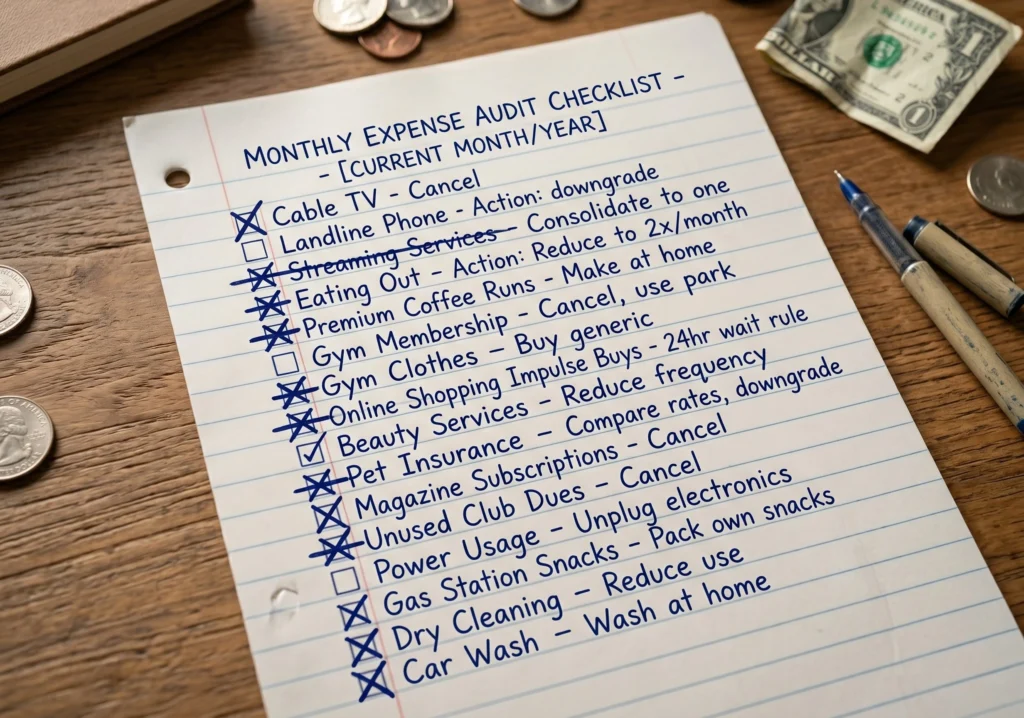
Start Here — Do a Full Monthly Expense Audit
Before making any cuts, you need a clear picture of where your money is actually going. Most people are surprised by what they find.
How to do a monthly expense audit in 20 minutes
- Log into your bank account and download or review your last three months of statements
- Categorise every transaction — housing, food, transport, subscriptions, entertainment, dining out, and miscellaneous
- Add up each category to see your monthly average
- Highlight everything that is non-essential or higher than expected
This one exercise almost always reveals at least three to five expenses you had forgotten about or that are higher than you realised. That is your starting point.
Cut 1 — Cancel Subscriptions You Do Not Use Weekly
Subscription services are the single biggest source of wasted monthly spending for most households. They are small enough to feel insignificant individually but devastating collectively.
How to find and cancel unused subscriptions
- Go through your bank statement and list every recurring charge
- For each one, ask yourself — did I use this in the last 30 days?
- Cancel immediately anything you cannot answer yes to
- Use an app like Rocket Money or Trim to automatically identify and cancel subscriptions on your behalf
Common subscriptions people forget they are paying for
- Streaming services — Netflix, Disney+, Hulu, HBO Max, Apple TV+
- Music — Spotify, Apple Music, Tidal
- Software — Adobe Creative Cloud, Microsoft 365, Dropbox, cloud storage plans
- News and magazine subscriptions
- Gym memberships used less than twice per week
- Premium app upgrades on apps you barely use
- Free trials that automatically rolled into paid plans
The average household has 12 active subscriptions. Cutting four or five unused ones typically saves $40–$100 per month immediately.
Cut 2 — Negotiate Your Internet and Phone Bills
Most people pay their internet and phone bills without ever questioning the amount. This is a mistake. Both are highly negotiable — especially if you have been a customer for more than 12 months.
How to negotiate your bills in one phone call
- Call your provider’s customer retention team — not general customer service
- Tell them you have seen a better deal from a competitor and are considering switching
- Ask what they can offer to keep your business
- Most providers will offer a discount of $10–$30 per month or upgrade your plan at no extra cost
This single phone call costs you 15 minutes and commonly saves $120–$360 per year. Do it for your internet provider and your phone provider separately.
Cut 3 — Reduce Your Grocery Bill
Food is one of the most controllable expenses in any household budget. Small changes to how you shop can save $100–$200 per month without eating less or worse.
Fastest ways to reduce your grocery spending
- Switch to store brand products for basics — typically 20–40% cheaper than name brands
- Meal plan weekly before shopping — eliminates impulse buys and food waste
- Use your supermarket’s loyalty app for digital coupons before each shop
- Buy seasonal produce which is always cheaper and fresher
For a complete guide to slashing your food bill, read our full post on how to save money on groceries.
Cut 4 — Reduce Your Energy Bills
Heating, cooling, and electricity are significant monthly expenses for most households — and most people are paying more than they need to.
Easy ways to lower your energy bills this month
- Turn your thermostat down by 1–2 degrees in winter and up by 1–2 degrees in summer — each degree saves roughly 1–3% on your heating and cooling bill
- Switch to LED bulbs throughout your home if you have not already — they use 75% less energy than traditional bulbs
- Unplug electronics and chargers when not in use — standby power consumption adds up
- Run your dishwasher and washing machine on off-peak hours if your energy provider charges variable rates
- Check if you are on the best available energy tariff — switching providers can save $200–$500 per year in deregulated markets

Cut 5 — Reduce Dining Out and Takeaway Spending
Dining out and ordering takeaway is one of the highest-spending categories for most households — and one of the easiest to reduce without feeling deprived.
How to cut dining costs without giving up eating out entirely
- Set a specific monthly dining out budget and track it actively
- Cook at home four to five days per week and treat eating out as an occasion rather than a default
- Meal prep on Sundays to reduce the temptation of ordering food when you are tired on weekday evenings
- When you do eat out, choose lunch over dinner — the same restaurants charge significantly less at lunch
- Delete food delivery apps from your phone — the convenience makes impulse ordering far too easy
The average household spends $250–$500 per month on dining out and takeaway. Cutting this by half saves $125–$250 every month.
Cut 6 — Review Your Insurance Policies
Most people pay their insurance premiums on autopilot without ever shopping around. Loyalty rarely pays in the insurance industry — in fact, many providers offer their best rates to new customers only.
[H3] How to reduce your insurance costs
- Get comparison quotes for your car, home, and health insurance once per year
- Bundle your home and car insurance with the same provider for a multi-policy discount
- Increase your excess or deductible if you have a healthy emergency fund — this lowers your premium significantly
- Ask your current insurer to match competitor quotes before switching
- Check you are not paying for coverage you no longer need
Shopping your insurance annually can save $200–$600 per year across car and home policies combined.
Cut 7 — Reduce Transportation Costs
After housing, transportation is typically the second largest monthly expense for most households. Even small reductions here make a noticeable difference.
Ways to reduce your monthly transport spending
- Refinance your car loan if interest rates have dropped since you took it out
- Drive more smoothly — aggressive acceleration and braking increases fuel consumption by up to 30%
- Keep your tyres properly inflated — under-inflated tyres increase fuel consumption
- Use public transport, cycle, or walk for shorter journeys where possible
- Carpool with colleagues if you commute to an office
- Compare fuel prices in your area using apps like GasBuddy before filling up
Cut 8 — Switch to Free Entertainment Options
Entertainment spending is highly discretionary — and there are more free options available today than ever before.
Free entertainment alternatives that cost nothing
- Public libraries offer free books, audiobooks, magazines, and in many cases free access to streaming services like Kanopy and Libby
- Free-to-air television covers most major sports events, news, and popular shows
- YouTube offers millions of hours of free content across every interest
- Community events, free museum days, hiking, and parks cost nothing
- Host social gatherings at home instead of going out — far cheaper and often more enjoyable
Cut 9 — Eliminate Credit Card Interest
If you are carrying a balance on a credit card and paying interest each month, that interest charge is one of the most expensive line items in your budget. Credit card interest rates typically range from 18–29% annually.
How to stop paying credit card interest
- Pay your full credit card balance every month — not just the minimum
- If you have existing credit card debt, transfer it to a 0% balance transfer card to stop the interest immediately
- Set up a direct debit for your full statement balance so you never miss a payment
- Cut up or freeze any credit cards you use for impulse spending
Eliminating $2,000 of credit card debt at 20% interest saves $400 per year in interest charges alone.
Cut 10 — Reduce Personal Care and Beauty Spending
Personal care products and beauty services are a significant monthly expense that most people never review.
Simple ways to reduce personal care costs
- Switch to store brand toiletries — shampoo, conditioner, moisturiser, and soap are almost identical in quality to premium brands at a fraction of the cost
- Extend the time between haircuts — going from every 6 weeks to every 8 weeks saves two to three haircuts per year
- Learn basic grooming skills at home — eyebrow shaping, at-home hair treatments, and basic manicures are easy to do yourself
- Buy personal care products in bulk when on sale — they have a long shelf life
Cut 11 — Stop Paying Bank Fees
Many people pay monthly bank account fees, ATM fees, overdraft fees, or foreign transaction fees without realising it. These are entirely avoidable costs.
How to eliminate bank fees immediately
- Switch to a fee-free bank account — many online banks offer completely free accounts with no monthly charges
- Use your own bank’s ATMs only to avoid out-of-network withdrawal fees
- Set up a low-balance alert to avoid overdraft fees
- Use a fee-free card for international purchases if you travel or shop from overseas retailers
Cut 12 — Review and Reduce Any Loan Payments
If you have personal loans, student loans, or a mortgage, there may be opportunities to reduce your monthly payments through refinancing or restructuring.
How to reduce your loan payments
- Refinance your mortgage if current rates are lower than when you took out your loan — even a 0.5% reduction saves thousands over the life of the loan
- Consolidate multiple personal loans into one lower-interest loan
- Make extra repayments when possible — this reduces the principal and therefore the total interest you pay
- Check if your student loan qualifies for income-based repayment plans that cap monthly payments
How Much Can You Save by Reducing Monthly Expenses?
The combined impact of these 12 cuts varies by household but here is a realistic breakdown of what most people save:
- Subscriptions: $50–$100/month
- Negotiated bills: $30–$60/month
- Groceries: $80–$150/month
- Energy bills: $30–$80/month
- Dining out reduction: $100–$200/month
- Insurance shopping: $20–$50/month
- Bank fees eliminated: $10–$30/month
Conservative total: $320–$670 per month in savings — $3,840–$8,040 per year.
Final Thoughts
Reducing your monthly expenses does not require dramatic lifestyle changes. It requires a one-time audit, a few phone calls, and a handful of small habit adjustments. The 12 cuts above are all achievable within the next 30 days.
Start with the audit — then tackle subscriptions and bill negotiation first since those give you the fastest wins with the least effort. Every dollar you free up from unnecessary expenses is a dollar that can go toward your savings goals instead.
For more ways to build your savings once your expenses are under control, read our guides on how much money should you save each month and how to save money for a house.
Which of these 12 cuts are you going to make first? Let us know in the comments below.
About the Author
James Carter writes about personal finance and smart money habits at GetWorldInfo.com. With over a decade of experience helping families budget smarter and cut everyday costs, James believes that saving money doesn’t require sacrifice — just the right strategy.



One Comment