









Key Takeaways
Table of Contents
- What Is Calisthenics and Why Is It Perfect for Beginners?
- Why calisthenics is ideal for beginners
- What results can beginners expect from calisthenics
- The 5 Foundational Calisthenics Movements Every Beginner Must Learn
- 1. The Push-Up
- 2. The Squat
- 3. The Plank
- 4. The Lunge
- 5. The Glute Bridge
- Your Complete Beginner Calisthenics Workout Plan (Weeks 1 to 4)
- How to structure your training week
- Week 1 and 2 – Building the foundation
- Week 3 and 4 – Building on the foundation
- How to Warm Up and Cool Down Properly
- A simple 5 minute warm-up for beginners
- A simple 5 minute cool-down for beginners
- The Most Common Beginner Calisthenics Mistakes
- Going too hard too soon
- Ignoring rest days
- Using bad form to hit a rep target
- Not tracking progress
- How to Progress Once You Have Mastered the Basics
- Natural progressions for each foundational movement
- What to Eat to Support Your Calisthenics Training
- Simple nutrition guidelines for beginner calisthenics
- Final Thoughts
- Calisthenics uses your own bodyweight as resistance, so you need zero equipment to get started
- Beginners should focus on mastering 5 foundational movements before progressing
- Three sessions per week with a rest day in between is the ideal starting frequency
- Proper form matters far more than the number of reps when you are starting out
- Most beginners see noticeable strength and fitness improvements within 4 to 6 weeks
Calisthenics is one of the most effective and accessible forms of exercise in the world. No gym membership, no expensive equipment, and no commute. Just your body, a small amount of floor space, and a workout plan that actually works. This guide gives you everything you need to start your calisthenics journey as a complete beginner and build real, lasting fitness from day one.
What Is Calisthenics and Why Is It Perfect for Beginners?
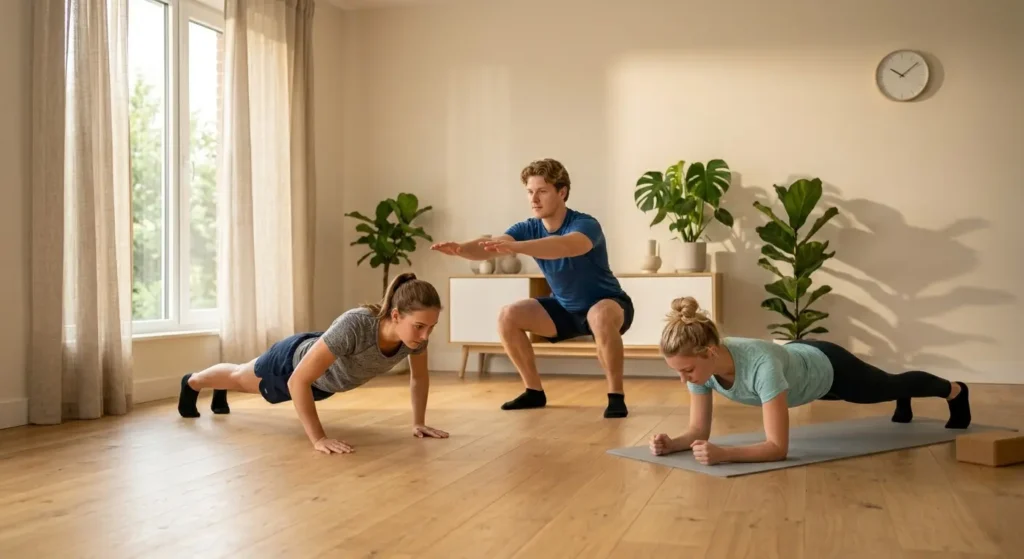
Calisthenics is a form of exercise that uses your own bodyweight as the only form of resistance. Push-ups, squats, lunges, planks, and pull-ups are all calisthenics movements. You are not lifting external weights. You are moving and controlling your own body, which builds genuine functional strength, flexibility, and cardiovascular fitness simultaneously.
Why calisthenics is ideal for beginners
It requires no equipment and no gym, making the barrier to entry essentially zero. You can do it anywhere, at any time, in any space large enough to lie down in. The movements are natural and intuitive, so the learning curve is gentle compared to weight training. It is also significantly lower risk for injury when starting out because you are only moving your own bodyweight rather than external loads you are not yet ready for.
What results can beginners expect from calisthenics
Within the first two weeks you will begin to notice improved body awareness and coordination. By week four most beginners report meaningful strength gains, better posture, and increased energy levels throughout the day. By week eight, with consistent training, visible changes in muscle tone and overall fitness are typical. The key is consistency over intensity, especially in the early weeks.
The 5 Foundational Calisthenics Movements Every Beginner Must Learn
Before following any workout plan, you need to understand and practice these five fundamental movements. Every calisthenics exercise you will ever do is a variation or progression of these basics.
1. The Push-Up
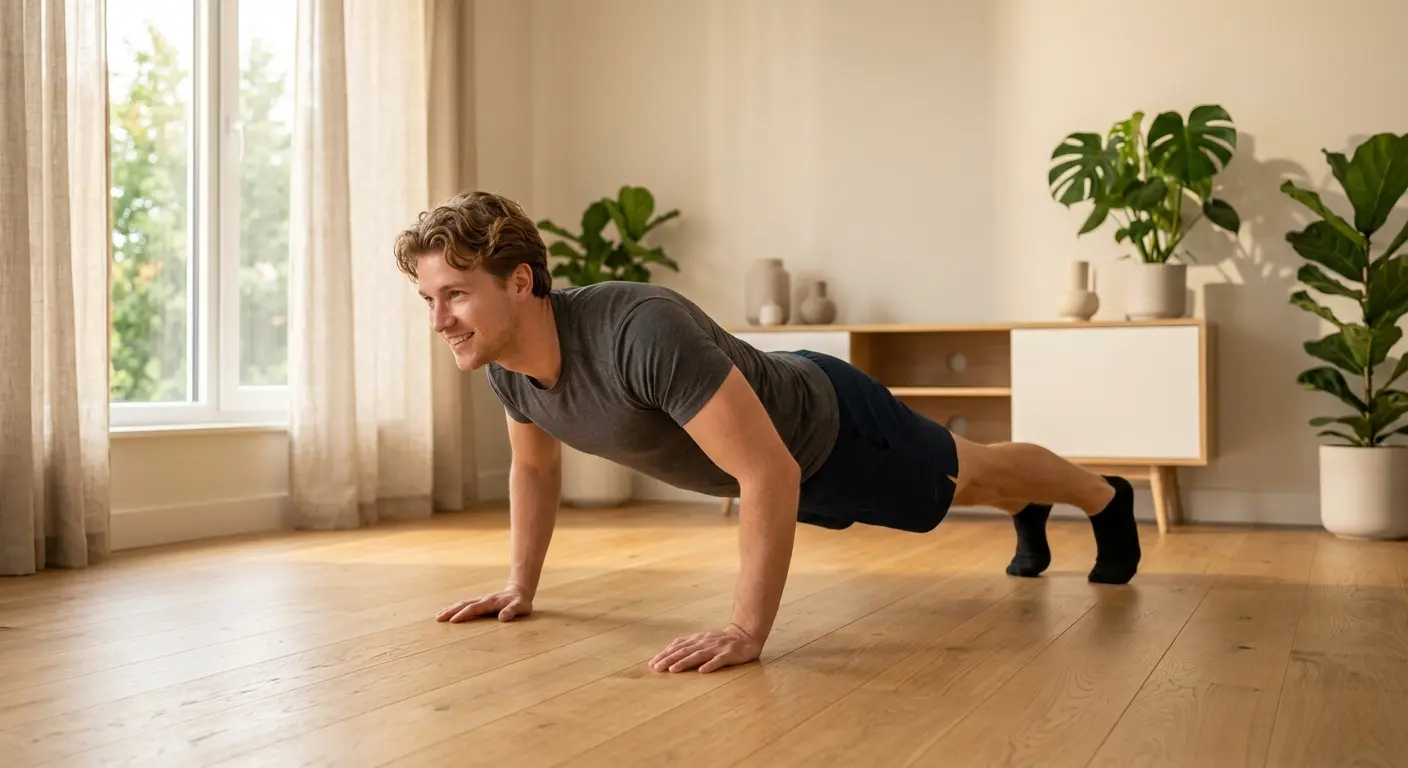
The push-up trains your chest, shoulders, triceps, and core simultaneously. It is the most important upper body calisthenics movement there is.
Beginner form guide:
- Start in a high plank position with your hands slightly wider than shoulder width
- Keep your body in a straight line from head to heels throughout the movement
- Lower your chest toward the floor by bending your elbows
- Push back up to the starting position
- If full push-ups are too difficult, start from your knees and build toward full ones
2. The Squat
The squat trains your quadriceps, hamstrings, glutes, and core. It is the foundational lower body movement in calisthenics.
Beginner form guide:
- Stand with your feet shoulder width apart and toes slightly pointed outward
- Push your hips back and bend your knees as if sitting down into a chair
- Lower until your thighs are parallel to the floor or as low as comfortable
- Drive through your heels to return to standing
- Keep your chest up and your weight in your heels throughout
3. The Plank
The plank builds core strength and stability, which underpins every other calisthenics movement. A strong core makes everything else better.
Beginner form guide:
- Start in a forearm plank position with your elbows directly below your shoulders
- Keep your body in a straight line from head to heels
- Squeeze your glutes and brace your core throughout
- Hold for as long as you can maintain perfect form, starting with 20 to 30 seconds
- Avoid letting your hips sag or rise up
4. The Lunge
The lunge trains each leg independently, which identifies and corrects strength imbalances between your left and right side. It also builds balance and coordination.
Beginner form guide:
- Stand upright and take a large step forward with one foot
- Lower your back knee toward the floor until both knees are at roughly 90 degrees
- Push through your front heel to return to standing
- Alternate legs with each repetition
- Keep your torso upright throughout
5. The Glute Bridge
The glute bridge trains your glutes, hamstrings, and lower back. It is particularly important for beginners who spend a lot of time sitting, as it reactivates muscles that become weak from extended sitting.
Beginner form guide:
- Lie on your back with your knees bent and feet flat on the floor
- Drive through your heels to lift your hips toward the ceiling
- Squeeze your glutes hard at the top of the movement
- Lower your hips back down with control
- Do not let your lower back arch excessively at the top
Your Complete Beginner Calisthenics Workout Plan (Weeks 1 to 4)
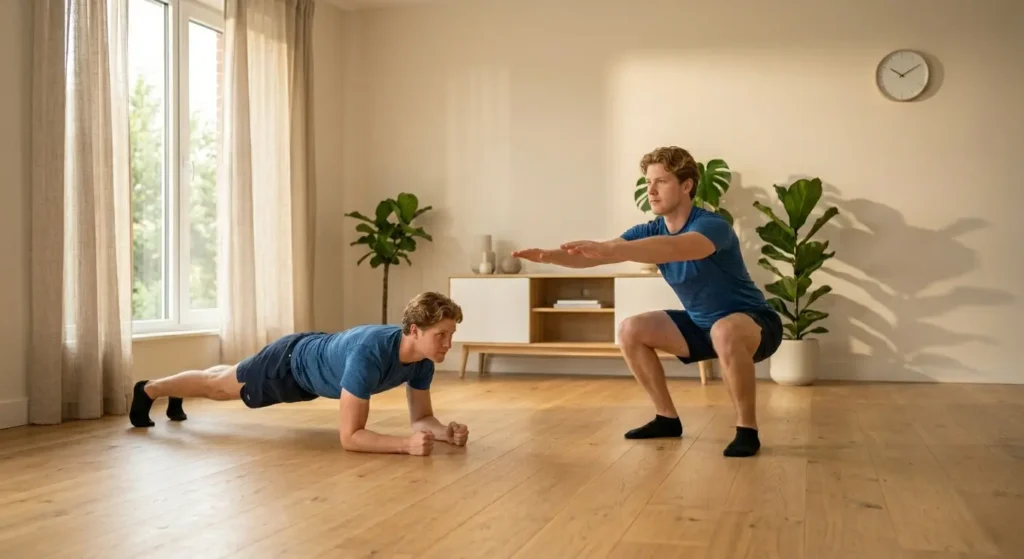
This is a structured four-week plan designed specifically for people who have little to no fitness experience. It starts easy and progressively increases in volume and difficulty each week.
How to structure your training week
Train three days per week with at least one rest day between each session. A Monday, Wednesday, Friday schedule works well for most people. Rest days are not optional – your muscles grow and recover on rest days, not during workouts.
Week 1 and 2 – Building the foundation
Perform each workout three times per week.
Workout:
- Push-ups: 3 sets of 5 to 8 reps (from knees if needed)
- Squats: 3 sets of 10 reps
- Plank: 3 sets of 20 second holds
- Lunges: 2 sets of 8 reps per leg
- Glute bridges: 3 sets of 12 reps
Rest 60 to 90 seconds between each set. The workout should take around 20 to 25 minutes. Focus entirely on form rather than the number of reps. If a set feels too easy, add 2 reps. If it feels impossible, reduce the reps until the form is solid.
Week 3 and 4 – Building on the foundation
Once the Week 1 and 2 workout feels manageable, progress to this slightly more challenging version.
Workout:
- Push-ups: 3 sets of 8 to 12 reps (full push-ups, from knees if needed)
- Squats: 3 sets of 15 reps
- Plank: 3 sets of 30 to 45 second holds
- Lunges: 3 sets of 10 reps per leg
- Glute bridges: 3 sets of 15 reps
- Mountain climbers: 2 sets of 20 reps (10 each leg)
Rest 60 seconds between sets. Total workout time should be around 25 to 30 minutes.
How to Warm Up and Cool Down Properly
Skipping your warm-up is one of the most common beginner mistakes. A proper warm-up prepares your muscles and joints for exercise and dramatically reduces your injury risk.
A simple 5 minute warm-up for beginners
- 60 seconds of marching on the spot with exaggerated arm swings
- 10 slow bodyweight squats focusing on range of motion
- 10 arm circles forward and 10 backward
- 10 hip circles in each direction
- 30 seconds of gentle jumping jacks at low intensity
A simple 5 minute cool-down for beginners
- 30 second chest stretch holding your arms behind your back
- 30 second standing quadriceps stretch holding each leg
- 30 second hamstring stretch bending forward toward your toes
- 60 seconds of slow deep breathing with your hands on your stomach
- 30 seconds of gentle shoulder rolls
Do not skip the cool-down. It reduces muscle soreness and improves flexibility over time.
The Most Common Beginner Calisthenics Mistakes
These are the mistakes that slow progress and increase injury risk for beginners. Knowing them in advance keeps you on the right track.
Going too hard too soon
The most common beginner mistake by far. Starting with a workout that is too intense leads to severe muscle soreness, loss of motivation, and often injury. The plan above is deliberately conservative for good reason. Stick to it even if it feels easy at first.
Ignoring rest days
More training is not always better. Your muscles repair and grow stronger during rest, not during the workout itself. Training every day as a beginner is counterproductive and leads to overtraining, which sets your progress back significantly.
Using bad form to hit a rep target
Ten push-ups with perfect form are worth far more than twenty push-ups with collapsing form. Bad form trains bad movement patterns that become harder to correct over time and increase injury risk. Always reduce the reps before compromising the form.
Not tracking progress
If you are not tracking your workouts you have no way of knowing whether you are improving. Keep a simple note on your phone or in a notebook with the date, the exercises, the sets, and the reps for each session. Watching the numbers increase over weeks is one of the most motivating things in fitness.
How to Progress Once You Have Mastered the Basics
After four weeks of consistent training you will be ready to progress. Calisthenics has a natural and satisfying progression system because the exercises get harder as you build strength.
Natural progressions for each foundational movement
Push-up progressions:
- Knee push-ups to full push-ups to diamond push-ups to archer push-ups
Squat progressions:
- Bodyweight squat to pause squat to jump squat to pistol squat
Plank progressions:
- Forearm plank to high plank to plank with shoulder taps to single-arm plank
Lunge progressions:
- Static lunge to walking lunge to reverse lunge to jumping lunge
Each progression should only be attempted once you can complete the previous level comfortably with good form for the required reps and sets.
What to Eat to Support Your Calisthenics Training
Exercise and nutrition work together. You do not need a complicated diet to support beginner calisthenics training but a few basics make a significant difference to your energy levels and recovery.
Simple nutrition guidelines for beginner calisthenics
- Eat enough protein to support muscle repair. Aim for around 0.7 to 1 gram of protein per pound of bodyweight per day. Good sources include eggs, chicken, fish, beans, lentils, Greek yogurt, and cottage cheese.
- Eat enough overall. Beginners sometimes under-eat while starting a new fitness routine. You need adequate calories to fuel workouts and recovery.
- Stay hydrated. Drink water consistently throughout the day and especially before, during, and after your workout.
- Time your meals sensibly. Eating a light meal or snack containing carbohydrates and protein about 60 to 90 minutes before training gives you energy without making you feel heavy during the workout.
Final Thoughts
Starting a calisthenics workout as a beginner is one of the best fitness decisions you can make. The exercises are effective, the progression is clear, the cost is zero, and the results are real.
Follow the four-week plan above consistently, focus on your form before your rep count, and give your body adequate rest and nutrition. Within a month you will be stronger, fitter, and more confident in your movement than when you started.
Once you have completed the beginner plan and want to take your home training further, read our guide on the best bodyweight exercises for beginners [LINK TO HF2] for more exercises to add to your routine and our starter workout routine at home [LINK TO HF3] for a more structured full-body program.
Which of the five foundational movements are you going to practice first? Leave a comment below and let us know how your first session goes.
About the Author
Ryan Foster writes about health, fitness, and personal finance at GetWorldInfo.com. With years of experience in home-based training and wellness, Ryan is passionate about making fitness accessible to everyone regardless of budget or experience level.











No Comments