** Key Takeaways **
- Setting a firm weekly grocery budget before you shop is the most important first step
- A shopping list based on a meal plan eliminates the two biggest budget killers — impulse buying and food waste
- Shopping the perimeter of the store keeps you away from expensive processed and packaged foods
- Comparing price per unit — not price per item — reveals which products are genuinely cheaper
- Most households can cut their grocery bill by 25–35% without changing what they eat
Grocery shopping on a budget is a skill — and like any skill, it gets easier and more automatic the more you practice it. The difference between someone who spends $400 per month on groceries and someone who spends $650 on the same quality of food is not income — it is strategy. This guide gives you that strategy, step by step.
Step 1 — Set Your Weekly Grocery Budget Before You Shop
The most important thing you can do before setting foot in a supermarket is decide exactly how much you are going to spend. A budget without a number is not a budget — it is a hope.
Realistic weekly grocery budgets by household size
Use these as your starting targets:
- Single person: $50–$75 per week
- Couple: $80–$120 per week
- Family of 3: $120–$160 per week
- Family of 4: $150–$200 per week
If you are currently spending significantly more than these figures, do not try to cut to the target overnight. Reduce by $20–$30 per week until you reach your target — gradual cuts are far more sustainable than drastic ones.
How to track your grocery spending in real time
- Use cash — withdraw your weekly grocery budget and leave your card at home. When the cash is gone, you are done.
- Use a notes app on your phone to track a running total as you add items to your trolley
- Check your receipt immediately after shopping and compare it to your budget
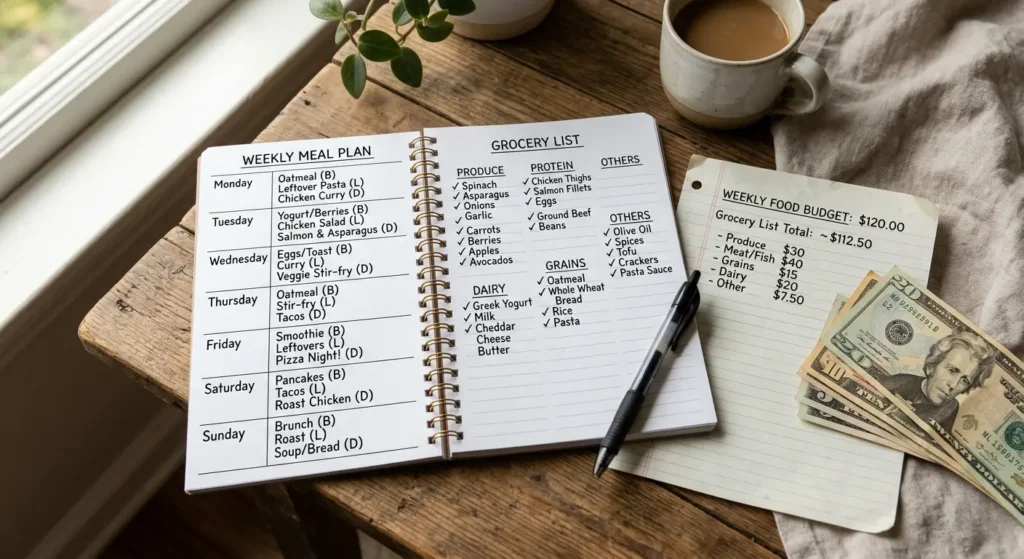
Step 2 — Build Your Shopping List From a Meal Plan
A shopping list built around a meal plan is the single most powerful budget grocery shopping tool available. Without it, you buy things you do not use and forget things you actually need.
How to build a budget meal plan in 10 minutes
- Decide on 5 dinners, 5 lunches, and 5 breakfasts for the week
- Check your fridge, freezer, and pantry first — plan meals around what you already have
- Choose recipes that share ingredients to minimise waste (e.g., buy one bunch of coriander used in two different meals)
- Write your shopping list from the meal plan — only what you need, nothing more
Budget-friendly meal ideas that stretch your money
- Soups and stews — cheap, filling, and easy to batch cook for the whole week
- Pasta dishes — incredibly affordable and endlessly variable
- Rice and beans or lentils — high protein, very cheap, and nutritious
- Egg-based meals — omelettes, frittatas, and egg fried rice are fast and cheap
- Stir fries with seasonal vegetables — quick, healthy, and budget-friendly
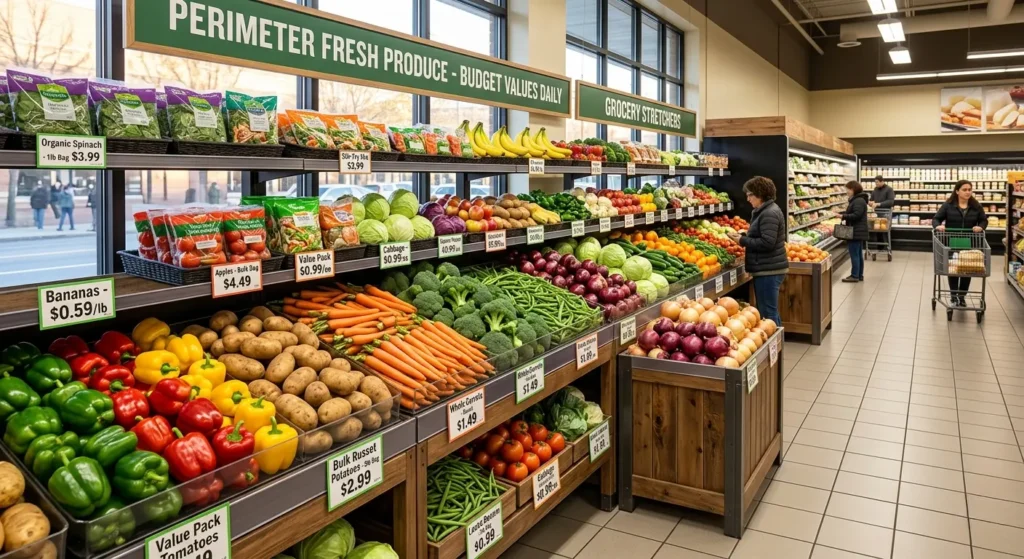
Step 3 — Shop the Perimeter of the Store First
Supermarkets are deliberately designed to lead shoppers through the middle aisles where processed, packaged, and high-margin products are displayed. The perimeter of the store — where fresh produce, dairy, meat, and bakery sections typically sit — is where the real food and the better value lives.
How to shop the perimeter effectively
- Start in the produce section and fill your trolley with seasonal fruit and vegetables first
- Move to the protein section — meat, fish, eggs, and dairy
- Head to the bread section last if needed
- Only go into the middle aisles for specific staples on your list — pasta, rice, canned goods, cooking oils
- Never browse the middle aisles without a specific item in mind
This simple change in shopping route reduces impulse buying dramatically.
Step 4 — Compare Price Per Unit, Not Price Per Item
One of the most common grocery shopping mistakes is comparing prices by the item rather than by unit. A larger pack almost always costs less per unit — but not always.
How to compare price per unit
Most supermarkets display the unit price — price per 100g, per litre, or per item — in small text on the shelf label. Always compare this number, not the headline price.
Examples:
- 400g pasta at $1.20 = $0.30 per 100g
- 1kg pasta at $2.80 = $0.28 per 100g → better value despite the higher price
- 500ml olive oil at $4.50 = $0.90 per 100ml
- 1 litre olive oil at $7.00 = $0.70 per 100ml → significantly better value
Training yourself to read unit prices takes a few weeks but becomes automatic quickly and saves a meaningful amount on every shop.
Step 5 — Choose Store Brands for Staple Items
For everyday staple items, store brand products deliver near-identical quality at 20–40% less than the equivalent name brand. This one habit alone saves most households $30–$60 per week.
[H3] Staple items where store brand is always a smart choice
- Rice, pasta, oats, and flour
- Canned tomatoes, beans, chickpeas, and lentils
- Butter, milk, and eggs
- Olive oil and vegetable oil
- Frozen vegetables
- Bread and wraps
- Cleaning products and dishwashing liquid
- Bin bags, cling film, and foil
Items where brand sometimes matters
There are a small number of products where brand preference is genuinely justified — usually things like a specific sauce, spice blend, or product with no real generic equivalent. Keep these on your list but make them the exception, not the rule.
Step 6 — Buy Frozen and Canned Produce
Fresh is not always better — and it is almost never cheaper. Frozen and canned fruit and vegetables are picked at peak ripeness and processed immediately, meaning their nutritional content is comparable to fresh produce. Their price is significantly lower.
Best frozen and canned items to stock up on
Frozen:
- Mixed vegetables (peas, corn, carrots, broccoli)
- Spinach and kale — frozen is a fraction of the cost of fresh
- Berries — excellent for smoothies and porridge
- Edamame, broad beans, and green beans
- Fish fillets and prawns
Canned:
- Chopped tomatoes — a kitchen essential for a fraction of fresh tomato cost
- Chickpeas, kidney beans, black beans, and lentils
- Tuna, sardines, and mackerel
- Coconut milk
- Sweetcorn
Stocking your freezer and pantry with these items gives you the foundation of dozens of meals at minimal cost.
Step 7 — Use Loyalty Cards and Digital Coupons Every Time
If you shop at the same supermarket regularly and you are not using their loyalty card or app, you are leaving money on the table every single week.
How to maximise loyalty card savings
- Sign up for every store loyalty programme at the supermarkets you use
- Open the app before each shop and clip every relevant digital coupon — it takes three minutes
- Check your personalised offers — most apps show discounts based on what you usually buy
- Accumulate points and redeem them against your grocery bill rather than for rewards
Regular loyalty app users save an average of $15–$30 per week on their grocery bill — that is up to $1,560 per year in savings for doing something that takes a few minutes each time.
Step 8 — Shop Alone and Shop Less Frequently
Two underrated grocery budgeting habits that make a significant difference.
Why shopping alone saves money
Every additional person in your trolley adds approximately 10–15% to your final bill. Children ask for treats. Partners add things not on the list. Shopping alone and sticking to your list is the simplest way to avoid this.
Why shopping less frequently saves money
Every additional trip to the supermarket is an opportunity for impulse spending. Aim to do one main weekly shop rather than multiple smaller trips. Plan well enough that you only need to return mid-week for absolute essentials like fresh milk or bread.
Step 9 — Reduce Food Waste Ruthlessly
Food waste is one of the most expensive and least visible parts of any grocery budget. The average household throws away 30% of the food it buys — effectively wasting nearly one third of every grocery shop.
How to reduce food waste and save money
- Store food correctly — most vegetables last significantly longer when stored properly in the fridge
- Use the FIFO method in your fridge — First In, First Out. Put new items at the back and older items at the front so older food gets used first
- Repurpose leftovers — last night’s roasted vegetables become today’s frittata or soup
- Freeze anything you will not use before it expires — bread, meat, cooked grains, and most vegetables freeze well
- Check your fridge before every shop and build meals around what needs using first
For a deeper look at food saving strategies, read our complete guide on how to save money on groceries
Step 10 — Avoid These Budget Grocery Shopping Mistakes
Even experienced budget shoppers make these mistakes. Knowing them in advance keeps you on track.
Common mistakes that blow your grocery budget
- Shopping when hungry — this is proven to increase spending by up to 60% on high-calorie, high-margin impulse items
- Buying pre-cut, pre-washed, or pre-portioned food — you pay a significant premium for convenience that takes 2 minutes to do yourself
- Assuming sale items are always good value — always check the unit price before assuming a promotional price is actually a deal
- Buying in bulk without checking expiry dates — bulk only saves money if you use everything before it expires
- Not checking the top and bottom shelves — supermarkets place higher-margin products at eye level. The best value items are often at the top or bottom of the shelf.
A Simple Weekly Budget Grocery Shopping Routine
Pull all of the above together into a simple repeatable weekly routine.
Your weekly budget shopping routine
- Sunday: Check your fridge and pantry, plan your meals for the week, write your shopping list
- Sunday evening or Monday morning: Open your store app, clip digital coupons, check personalised offers
- Shopping day: Go alone, take your list, stick to it, compare unit prices, start in the produce section
- After shopping: Check your receipt, note your total, and compare to your budget
Repeat this every week and within a month it becomes completely automatic. Your grocery bill will drop noticeably in the first two to three weeks.
Final Thoughts
Learning how to grocery shop on a budget is one of the highest-return financial habits you can build. The time investment is minimal — a few minutes of planning before each shop — and the savings are real and immediate.
Start with the meal plan and shopping list this week. Add the unit price comparison habit the week after. Layer in loyalty coupons the week after that. Within a month you will have a complete budget grocery system running on autopilot.
To take your food savings even further, read our guide on how to reduce monthly expenses — food is just one of twelve areas where you can free up significant money every month.
How much do you currently spend on groceries each week? Let us know in the comments — and share any budget shopping tips that have worked for you.
About the Author
James Carter writes about personal finance and smart money habits at getworldinfo.com. With over a decade of experience helping families budget smarter and cut everyday costs, James believes that saving money doesn’t require sacrifice — just the right strategy.